
United States
Buy US Virtual Phone Numbers
Give American customers a local or toll-free US number they trust, and answer it from wherever your team works. Choose numbers in New York, Los Angeles, Chicago, Miami, and all other US markets.
Choose Your Number
Trusted by over 5,000 global brands


















US Virtual Phone Numbers for Business
AVOXI virtual phone numbers give your business a local presence in all 50 states without a US entity or office. Customers dial a domestic number from any US landline or mobile, so they never pay international calling rates to reach you.
Each US number is a DID, short for direct inward dialing: a number that rings straight through to whoever you assign it to. Route it to a softphone, a mobile app, your contact center, or the cloud business phone system your team already uses, anywhere in the world.

Buy US Phone Numbers Online
AVOXI offers three US number types. Pick the one that matches how your team talks to customers.

Local DID Numbers
(Direct Inward Dialing)
Build a local presence in a specific city or state.

Toll-Free Numbers
Run national support and sales lines that cost callers nothing to dial.
TrueLocal Numbers
Get more of your outbound calls answered.

US Local DID Numbers
US numbers follow the North American Numbering Plan: a three-digit area code plus a seven-digit local number, written as +1 XXX XXX XXXX internationally. AVOXI offers local DID numbers in cities across all 50 states, and ten-digit dialing is standard in most areas.
Popular area codes include 212 and 646 for New York City, 213 and 310 for Los Angeles, 312 for Chicago, 305 for Miami, 404 for Atlanta, 214 for Dallas, and 617 for Boston. Whichever you choose, a US local number can ring a team in any country.
US Toll-Free Numbers
US toll-free numbers run on seven active prefixes: 800, 888, 877, 866, 855, 844, and 833. Callers treat them the same, though 800 is still the most recognized. The FCC has reserved 822 as the next prefix but hasn't announced a release date.
Toll-free numbers move between providers through the RespOrg system, where a responsible organization manages each number's routing. You can bring an existing toll-free number to AVOXI and take it with you if you ever leave.


Two-Way Local Caller ID & Outbound Trust in the US
US carriers block calls or label them "Spam Likely" when the caller ID fails authentication or looks unfamiliar. Since June 30, 2021, the FCC has required voice providers to use STIR/SHAKEN, a framework that digitally signs each call so the receiving carrier can verify the number is legitimate. FCC rulemaking on these standards is still ongoing.
With two-way local caller ID, TrueLocal displays a local US number when your team handles outbound calling, and takes callbacks on that number through the PSTN, the public telephone network every carrier connects to. Teams using it see up to 2x answer rates. User licenses unlock custom outbound caller ID and a desktop softphone on any AVOXI number.
Enterprise-Grade Voice Quality for Calls to and from US

Tier 1 Networks
Your calls travel over Tier 1 networks and secure connections.

4.49+ MOS Score
MOS, or mean opinion score, rates call clarity on a scale of 1 to 5. AVOXI calls score 4.49+.

Real-Time Alerts
Automated monitoring flags security risks and suspicious traffic on your numbers as it happens.

VoIP Quality Analytics
Track latency, jitter, and packet loss on every call, and fix problems before customers hear them.
Run Your US Voice Operations From One Platform
How to Buy US Virtual Phone Numbers Online
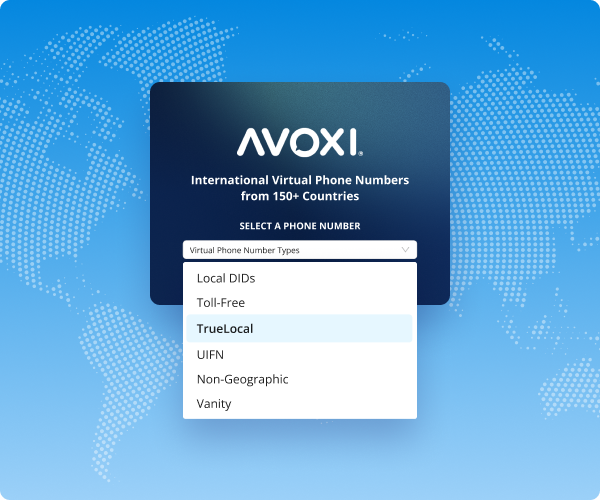
Choose Your Number
Pick a local, toll-free, or TrueLocal number, or port your existing numbers to AVOXI.
Confirm Your Account
If your sign-up email isn't tied to the business you listed, an AVOXI expert confirms your details, usually in 15 minutes or less.
Configure Your Calls
Set up forwarding, call routing, and IVR menus in the AVOXI platform.
Connect and Go Live
Link the number to your contact center, Microsoft Teams, or UCaaS platform and start taking calls.
Key Regulations for Voice Services in United States
The FCC regulates US voice services at the federal level, and AVOXI operates as an interconnected VoIP provider. That status carries obligations for caller ID authentication, emergency calling, number portability, and customer data protection.
- STIR/SHAKEN: Voice providers must authenticate caller ID under the FCC's call authentication rules, in force since June 30, 2021.
- Kari's Law and RAY BAUM'S Act: Since February 16, 2020, multi-line phone systems must let users dial 911 directly. RAY BAUM'S Act adds that 911 calls send a dispatchable location, such as a street address plus floor or suite. The FCC explains both in its 911 requirements for multi-line telephone systems.
- Number portability: You can keep your number when you switch providers, and the FCC requires simple ports to finish within one business day. See the FCC's guide to keeping your phone number.
- TCPA: The Telephone Consumer Protection Act requires consent for autodialed, prerecorded, or artificial-voice calls and texts, plus an easy opt-out. Check consent questions with your own legal counsel.
- CPNI: Customer proprietary network information covers call details and account data. The FCC tightened authentication rules in 2023 to fight SIM-swap and port-out fraud.
- USF contribution: Interconnected VoIP providers register with the FCC and pay into the Universal Service Fund based on revenue. This typically doesn't change your pricing or setup.
AVOXI built its US voice infrastructure to support caller ID authentication and emergency calling requirements, along with number portability. The AVOXI team can help you confirm which rules apply to your use case.
FAQs About US Virtual Phone Numbers
The cost of a US virtual phone number depends on the number type you choose and your expected call volume. AVOXI’s Basic plan starts at $7.99 per month.

Have Questions About Setting Up Business Phone Numbers?
Talk to an AVOXI expert about the right mix of US numbers for your team.