AI voice agents may perform well in lab conditions, but in highly pressured, real-life environments, they depend on clear, low-latency audio to transcribe accurately, detect intent, and respond naturally. Poor voice infrastructure degrades every layer of the AI stack, from speech recognition accuracy to customer satisfaction.
This guide breaks down:
- What does voice quality mean when AI agents are processing the audio
- Why quality breaks down during AI-powered interactions
- The infrastructure requirements for AI-ready voice
- How to evaluate whether your current voice layer is ready
- How to build a voice foundation that scales with AI
Ready to future-proof your voice layer for AI?
AVOXI's AI-ready voice platform delivers low-latency global voice across 9 cloud points of presence, with voice streaming optimized for real-time AI processing.
What Voice Quality Means in the Context of AI Agents
Traditional voice quality benchmarks were designed for human ears. AI voice agents raise the bar because they process audio programmatically, and every millisecond of latency or fraction of packet loss compounds across the pipeline.
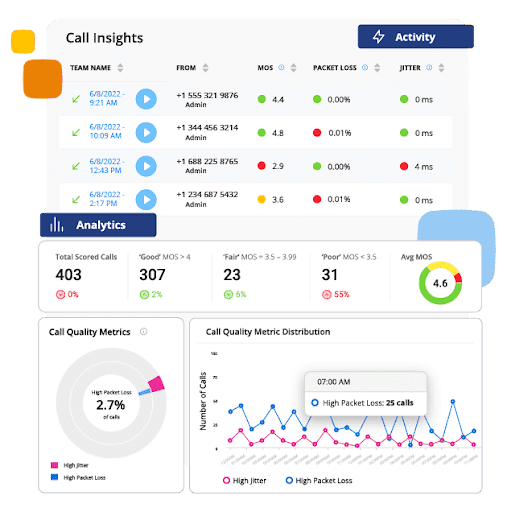
Key Metrics: MOS, Latency, Jitter, and Packet Loss
Mean Opinion Score (MOS) measures perceived call quality on a 1-to-5 scale. For human callers, a MOS above 3.5 is acceptable. AI agents need consistently higher scores because automated speech recognition (ASR) models trained on clean audio lose accuracy rapidly as input quality declines.
Latency measures the delay between when a caller speaks and when that audio reaches the AI engine. Jitter captures variation in that delay, which causes packets to arrive out of order. Packet loss means chunks of audio never arrive at all. Each metric independently degrades AI performance, and together they can make an agent unusable.
Why AI Voice Has Higher Stakes Than Traditional VoIP
A human caller can fill in gaps, ask someone to repeat themselves, or tolerate a brief delay. An AI agent cannot. ASR engines misinterpret words when packets drop.
Natural language understanding (NLU) models misclassify intent when jitter distorts sentence cadence. Text-to-speech (TTS) responses sound robotic or arrive too late when latency spikes. The result is a conversation that feels broken to the customer, even though the AI model itself is performing correctly
Why Voice Quality Breaks Down for AI-Powered Interactions
Most enterprise voice infrastructure was built for human-to-human calls. It works well enough for that purpose, but AI agents expose weaknesses that were previously invisible – we look at some of the issues that can arise below.
Codec Mismatches and Transcoding Overhead
When the codecs on the two ends of a call don't match, the audio is transcoded midstream. Each transcoding step introduces latency and can degrade fidelity. AI agents are particularly sensitive to this because ASR models expect consistent audio encoding.
A codec mismatch that a human caller would never notice can push word error rates above acceptable thresholds.
Routing Latency and POP Coverage Gaps
Voice traffic routed through a small number of centralized data centers accumulates latency as it crosses regions. For traditional calls, an extra 50 milliseconds is imperceptible.
For an AI agent that needs to transcribe, process, and respond in real time, that delay stacks on top of the model's own inference time. The conversation starts to feel sluggish, and callers disengage.
The Multinational Compounding Problem
International calls traverse more network hops, cross more carrier boundaries, and pass through more points of potential degradation. Each hop adds jitter and increases the odds of packet loss. A call routed from Southeast Asia through a single European POP to a North American AI engine might accumulate enough latency to make real-time interaction impractical.
This is the scenario AI agents handle worst: Inconsistent, variable-quality audio arriving from diverse global endpoints.
Key Infrastructure Requirements for AI-Ready Voice
Deploying AI agents on voice channels requires infrastructure designed for low-latency, high-fidelity audio from the start, not retrofitted after quality issues surface in production.
Low-Latency Routing and Edge Proximity
Cloud points of presence (POPs) positioned close to end users reduce the distance audio travels before reaching the AI engine. Edge proximity matters most for international deployments, where the gap between a nearby POP and a distant one can mean the difference between 40 and 200 milliseconds of round-trip time.
AI agents need routing that prioritizes the shortest viable path, not just the cheapest one.
Carrier Partnerships and MOS Consistency
Not all carriers deliver the same audio quality. Tier 1 carriers maintain dedicated infrastructure and peering arrangements that produce more consistent MOS scores across geographies.
A voice platform backed by a deep carrier network can dynamically route around degraded paths, maintaining the audio fidelity AI agents require even when individual carrier segments experience issues.
Voice Streaming and Media Handling
Traditional voice platforms pass audio through multiple processing stages before it reaches an application. AI agents benefit from architectures that stream audio directly to the AI engine with minimal intermediate processing. Voice streaming reduces latency and preserves audio fidelity by eliminating unnecessary transcoding, buffering, and routing hops between the caller and the model.
Proactive Monitoring and Analytics
Quality degradation in AI voice deployments often goes undetected until customers complain. Proactive monitoring via call quality analytics identifies issues at the infrastructure layer before they reach the AI model. Real-time visibility into MOS, jitter, and packet loss per call segment lets operations teams identify and resolve problems before they affect agent performance at scale.
How to Evaluate Your Voice Infrastructure for AI Readiness
Before deploying AI agents on live voice channels, teams need a clear picture of whether their current infrastructure can meet the required quality standards.
Performance Audit: MOS, Latency, and Codec Support
Begin with baseline measurements. Track MOS scores across your highest-volume call routes for at least two weeks. Flag any route that consistently drops below 4.0, since that threshold marks where ASR accuracy begins to decline noticeably.
Map latency by region and identify routes with round-trip times exceeding 150 milliseconds. Confirm that your platform supports wideband codecs (G.722, Opus) without forced transcoding.
Integration Considerations
AI voice deployments rarely stand alone. Evaluate whether your voice platform supports SIP trunking for flexible connectivity to your existing contact center stack. Check for programmable voice APIs that let your engineering team route, record, and stream audio to AI engines without building custom middleware. Direct media streaming to AI platforms reduces latency by cutting out intermediary hops.
Red Flags to Watch For
Single-carrier dependencies create risk. If your primary carrier experiences degradation on a key route, there is no failover path to maintain audio quality. High transcoding rates signal codec mismatches that compound under AI workloads.
The absence of real-time quality visibility means problems surface only after they affect customer interactions. Any of these conditions should be resolved before AI agents go live.
Building a Voice Foundation That Scales With AI
The infrastructure decisions made today determine how well AI voice agents perform at scale tomorrow. Teams that treat voice quality as an afterthought end up debugging AI accuracy problems that are really network problems.
Global Carrier and POP Architecture
A voice platform with broad geographic coverage and carrier diversity gives AI deployments a stable audio foundation. AVOXI, for example, operates 9 cloud POPs across major regions (US East, Brazil, UK, Germany, Middle East, South Africa, Singapore, Hong Kong, and Australia) and partners with 80+ Tier 1 carriers to maintain an average MOS of 4.49+ across 150+ countries.
That kind of infrastructure delivers the low-latency, high-fidelity audio AI agents need to perform reliably on international call routes.
The Consolidation Advantage
Running voice traffic through multiple regional providers introduces quality variance that AI agents struggle to handle. Different providers use different codecs, routing logic, and monitoring tools, so the same AI model can perform well on one provider's traffic but fail on another's.
Consolidating onto a single global voice platform eliminates that variance. One routing engine, one set of quality benchmarks, one monitoring dashboard, and consistent audio quality regardless of where the call originates.
Evaluating your voice infrastructure for AI readiness?
AVOXI's global voice platform is built for the latency, fidelity, and streaming requirements AI agents demand across every region you operate in.
FAQs About Voice Quality for AI Agents
What MOS score do AI voice agents need to perform reliably?
Most ASR engines deliver acceptable accuracy at a MOS of 4.0 or above. Below that threshold, word error rates climb, and intent detection becomes inconsistent. Enterprise teams running AI agents at scale should target a sustained MOS of 4.3+ across all active call routes to maintain reliable transcription and natural-sounding responses.
Can existing contact center voice infrastructure support AI agents?
It depends on the infrastructure's age and architecture. Legacy systems built around TDM or early SIP implementations often lack the codec flexibility, low-latency routing, and real-time monitoring AI agents require. Cloud-native voice platforms designed for programmable media handling are better positioned to support AI workloads without extensive retrofitting.
How do cloud points of presence improve voice quality for AI applications?
POPs reduce the physical distance audio travels between the caller and the processing engine. Shorter paths mean lower latency and less exposure to jitter and packet loss. For AI agents, this translates to faster transcription, more accurate intent detection, and more natural conversational pacing, especially on international routes where distance-related degradation is most pronounced.
What role does SIP trunking play in AI voice deployments?
SIP trunking provides the connectivity layer between your voice platform and your contact center or AI engine. A well-configured SIP trunk supports wideband codecs, direct media paths, and flexible routing rules that minimize latency. It also enables programmable call control, allowing engineering teams to stream audio directly to AI models without routing through unnecessary intermediaries.

You Might Also Be Interested in
Your AI Stack Is Only as Good as Your Voice Layer: A Guide for IT Directors

Need Help Getting US Phone Numbers?
We're here to help! Contact us today so we can help find the right business phone number for you.