

How to Set Up a Call Center (Step-by-Step Checklist)
Most call center software guides walk you through hiring agents, writing scripts, and configuring workflows. Those pieces matter, but they don't determine whether your contact center scales reliably. That outcome is decided earlier—when you architect your voice infrastructure. Which providers you choose, how you source phone numbers across markets, and how you design routing and failover all compounds over time. Get them right, and expansion is straightforward. Get them wrong, and you'll spend years patching a fragile system.
This guide is built for organizations that already understand Contact Center as a Service (CCaaS) fundamentals and want clarity on the voice layer that supports them. It focuses on designing global voice architecture that delivers long term flexibility, observability, and resilience instead of short term enablement.
Key takeaways
- Setting up a call center requires early voice architecture decisions that shape reliability, scale, and customer satisfaction.
- Phone numbers, caller ID, and call routing design directly influence answer rates, trust, and compliance.
- Monitoring call quality during setup helps teams prevent issues instead of reacting after customers complain.
- A unified global voice layer allows call centers to expand into new regions without reworking core infrastructure
Call Center Setup for Enterprise: A Step-by-Step Guide
The following steps focus on the voice infrastructure decisions that affect every call your contact center handles. Each one builds on the last, so skipping ahead creates gaps you'll need to fill later.
Step 1: Define Your Call Center Voice Requirements Early
Voice requirements should be locked in before you evaluate CCaaS platforms or sign service provider contracts. You need to determine answer rates, compliance risk, vendor sprawl, and how much time your support team spends troubleshooting internet connection issues.
This planning matters because phone calls are still the channel customers rely on most when customer interactions feel complex or urgent. Recent McKinsey research shows that live phone support continues to play a critical role in customer service, reinforcing why early voice decisions have a lasting impact on experience and performance.
Telecom teams that treat voice as an afterthought end up managing multiple regional carriers with inconsistent SLAs and no clear path to expansion.
Countries, Coverage, and Number Types
Begin by mapping where calls originate and where they terminate. Country-level coverage matters because telecom rules and provider availability vary widely by market. In some regions, number provisioning requires additional lead time, documentation, or local presence, which can affect your launch timelines if you don’t plan ahead.
Number selection should follow use cases rather than convenience. Different number types set different expectations for your customers and influence how calls perform across regions.
| Number Type | Primary Use Case | Typical Advantage | Key Consideration |
|---|---|---|---|
| Local DIDs | Regional inbound calls | Familiar local presence | Often requires country-specific documentation |
| International toll-free | Centralized customer access | Simplifies inbound reach | Availability varies by market |
| UIFN | Consistent global entry point | Single number across countries | Limited country coverage |
| Two-way local numbers | Inbound and outbound programs | Supports local presence in both directions | Outbound regulations must be verified |
Many teams underestimate the documentation and regulatory requirements tied to number ownership, residency rules, or local approval processes. Addressing these constraints early helps you avoid delays and prevents forced redesigns once deployment is underway.
Inbound and Outbound Call Flows
Next, define the call flow through your environment. Service-driven flows prioritize availability and continuity, while sales-driven workflows emphasize reach and answer rates. Hybrid models require balance across both goals.
As you design flows, account for callbacks, peak traffic, and overflow paths. These scenarios highlight where routing requires flexibility and where potential failure points may arise. Outbound planning also belongs here. Caller ID behavior and local presence should align with inbound expectations, so trust remains consistent across every interaction.
Step 2: Choose the Right Voice Infrastructure for Your Call Center
With your business needs defined, you can now evaluate infrastructure models. Legacy voice architectures often struggle as call volumes and geography expand, largely due to fragmented ownership and limited visibility. Modern cloud-based Voice over Internet Protocol (VoIP) platforms centralize control and simplify management at scale.
Selecting the right model early on reduces operational friction as complexity increases.
SIP Trunking vs. Regional Carriers
Many enterprises rely on multiple regional carriers to support global operations. Over time, this approach creates inconsistent service levels and fragmented support paths. Troubleshooting often requires manual coordination across multiple vendors, which slows down the resolution process.
Session Initiation Protocol (SIP) trunking helps unify connectivity, but protocol alone does not guarantee quality. Global performance depends on how your providers architect routing, redundancy, and monitoring. A fragmented SIP strategy can create the same problems as regional carrier sprawl if your architecture lacks cohesion.
➜ Related: VoIP vs. SIP: Key Differences, Benefits, and How to Choose
Cloud Voice Built for CCaaS
Modern call center services benefit from separating responsibilities. CCaaS platforms manage call center agents, queues, and routing logic, while specialized voice and VoIP platforms handle global connectivity and quality control.
This separation enables:
- Greater scalability through cost-effective bring your own carrier (BYOC) models
- Cleaner platform migrations over time
- Reduced dependency on a single vendor
By decoupling voice from application layers, you can preserve flexibility as needs evolve.
Step 3: Set Up Call Center Phone Numbers Correctly
Phone system numbers shape how customers perceive your calls and whether they answer them. Because numbering choices influence reach and compliance, you need to treat them as part of your core voice design rather than interchangeable assets. A clear numbering strategy supports the customer experience while protecting outbound deliverability as volume scales.
Local and Toll-Free Numbers by Market
Number choice should follow customer expectations by region. In North America, toll-free numbers often align with customer support use cases and signal legitimacy. In many other markets, local numbers perform better because customers associate them with nearby operations. As a result, a single global numbering model rarely works well.
Regulatory requirements also shape timelines. Many countries require documentation before activating local numbers, which can delay your rollout even when systems are ready. Since these rules vary, it’s diligent to confirm these requirements early. The same applies to portability. Some markets limit or prohibit number transfers, so you should account for long-term flexibility during provider selection.
Local Caller ID for Outbound Calls
Outbound call center performance now depends heavily on caller identity. Spam filtering and fraud controls determine whether calls reach customers at all. When teams use local caller ID through telephony systems, recipients recognize the area code and are more likely to answer. Toll-free or international numbers face a higher risk of being ignored or blocked.
And this environment continues to tighten. The U.S. Federal Communications Commission reports that carriers block large volumes of unwanted calls, which makes number reputation a core factor in outbound reach rather than a secondary concern.
Regulatory oversight reinforces this reality. Frameworks such as Stir and Shaken in the United States verify caller ID authenticity, while other regions apply similar controls. Providers often manage these requirements, but you should confirm support before launching outbound traffic to protect deliverability and compliance.
Step 4: Design Call Routing and Failover for Reliability
Routing and failover define how your call center behaves under pressure. These capabilities form part of your core architecture and directly support SLA commitments and service continuity.
Intelligent Routing and Overflow Strategies
Routing should adapt to how customers call and how your agents operate across regions. Effective strategies commonly include:
- Time-based routing that shifts traffic by business hours and time zones
- Geo-based routing that directs calls to nearby locations for lower latency and better language alignment
- Skills-based routing that connects specialized inquiries to trained agents
As traffic increases, overflow handling becomes equally important. When primary queues reach capacity based on the number of calls, overflow paths redirect calls to alternate locations or backup resources. Planning these paths up front helps maintain experience during demand surges and partial disruptions.
Automatic Failover Across Destinations
Failover protects service when primary routes fail, yet coverage needs to extend beyond a single scenario, such as:
- SIP-to-SIP failover reroutes calls between providers during connectivity issues
- SIP-to-Public Switched Telephone Network (PSTN) failover shifts traffic to traditional networks using dialers during internet outages
- Multi-site failover distributes calls across separate locations when an entire site goes offline
Design alone is not enough. Your teams need to document and test failover regularly. Controlled drills that disable primary routes using automation confirm whether your backups activate quickly enough to avoid dead air or dropped calls and maintain wait time standards. Plus, consistent testing ensures failover performs as expected when conditions change.
Step 5: Monitor Call Quality from Day One
Many call center solutions teams look at real-time call quality only after their customers complain. By then, issues have already affected the customer experience and consumed agent time. For this reason, monitoring needs to begin during setup, not after launch. Early visibility allows you to detect patterns before they escalate into widespread problems.
Voice Quality Metrics That Matter
Call quality monitoring works best when you understand which call center metrics and KPIs signal risk and why they matter:
- Mean Opinion Scores (MOS) reflect perceived audio quality and highlight degradation that customers can hear
- Jitter shows instability in packet delivery that leads to distortion
- Packet loss indicates missing voice data that causes choppy audio
- Latency measures the delay that disrupts natural conversation flow
These metrics connect directly to customer relationship management. Poor audio increases misunderstandings and extends average handle time, while dropped calls force customers to repeat effort. To avoid blind spots, track metrics at the call level rather than relying only on averages, which can hide isolated but severe issues.
Proactive Troubleshooting Workflows
Monitoring delivers value only when it leads to action. Alerting with AI-powered systems should notify your teams as soon as quality drops below acceptable thresholds, which shortens the gap between detection and resolution. Automated alerts reduce reliance on customer reports and limit the spread of issues.
Effective troubleshooting also requires root cause visibility. When quality degrades, you need to identify whether the issue originates within the network, your voice provider, an interconnect partner, or the endpoint. Providers that surface this detail through diagnostic tooling allow you to resolve problems faster and with less coordination overhead.
Step 6: Launch, Test, and Scale Your Call Center Voice
A phased launch lowers risk and gives team members time to validate voice behavior before customers feel the impact. When organizations push everything live at once, configuration gaps often surface only after calls fail. Gradual rollout allows you to confirm assumptions and correct issues while traffic remains manageable.
Pre-Launch Testing and Validation
Testing should confirm that numbers, routing, and capacity behave as expected under real conditions:
- Validate incoming calls and outgoing calls across carriers and device types.
- Confirm local caller ID displays correctly and avoids filtering with CRM integration.
- Walk through every routing path, including Interactive Voice Response (IVR) branches and overflow logic.
- Simulate peak volumes using Automatic Call Distribution (ACD) to identify queue limits and channel constraints.
Documenting results and fallback paths ensures you can repeat the process as environments change.
Scaling into New Regions
Expansion works best when virtual call center teams follow the same discipline used during initial setup, whether using in-house, outsourced, or hybrid staffing models with on-site and remote agents. Research regulatory requirements for on-premises vs. cloud, documentation needs, and number availability before committing to launch dates, since lead times vary by market.
Capacity growth becomes easier when voice runs through a single global layer. With proper onboarding and workforce management, you can add numbers, increase concurrency, and activate new regions without reworking routing or support processes. Over time, this consistency reduces operational effort and keeps your scaling predictable.

➜ Pro tip: Bringing the voice layer together.
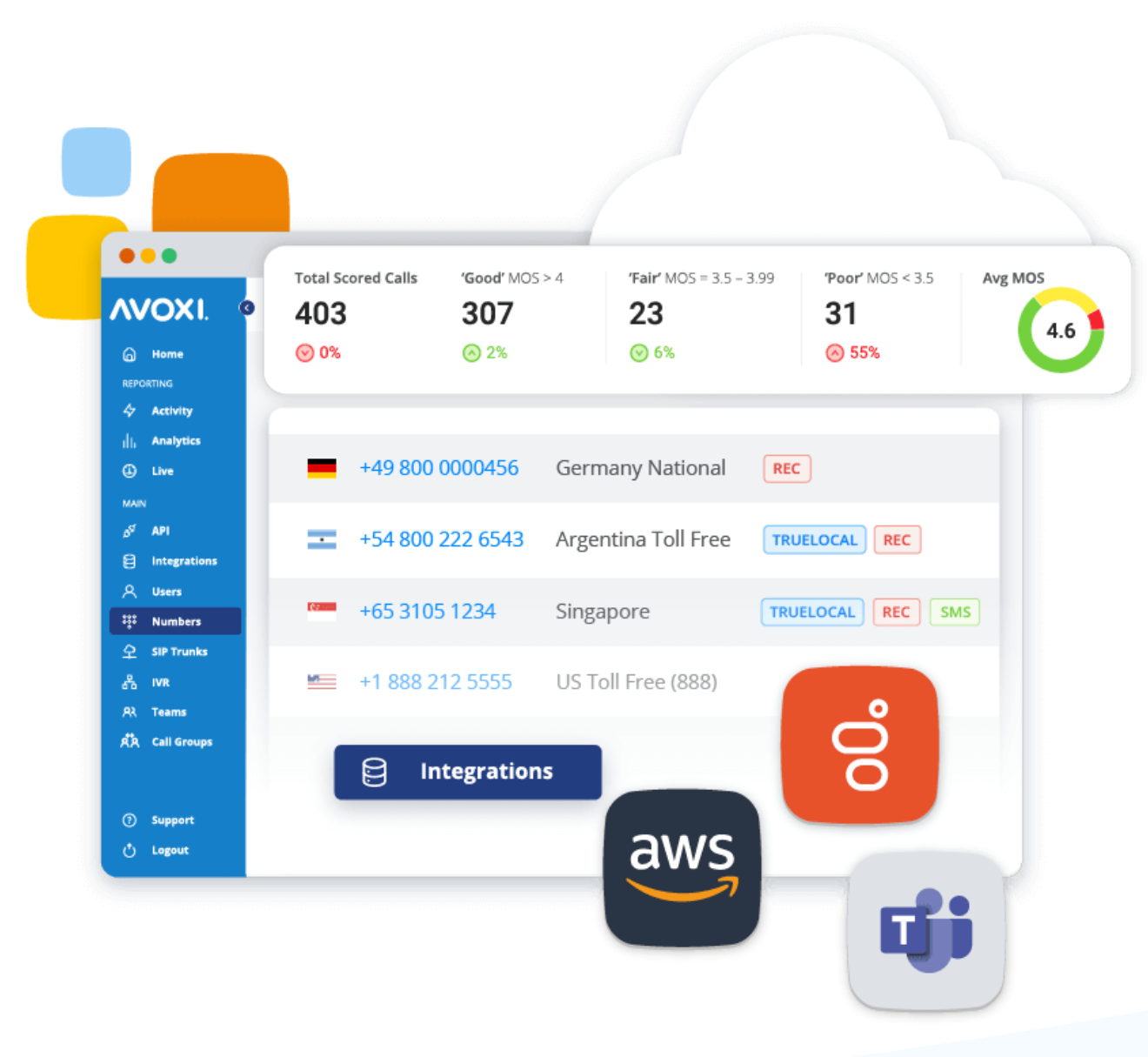
Once you complete these steps, maintaining consistency becomes critical. A unified global voice platform—one that manages numbering, outbound identity, routing, and connectivity in a single layer—allows you to expand into new regions and scale volume without reworking core architecture or adding providers.
Final Checklist for a Future-Ready Call Center Setup
Use this checklist to build a successful call center with voice infrastructure that supports long-term scalability:
- Define voice requirements before selecting CCaaS platforms.
- Verify regulatory requirements and documentation for each target market.
- Select a voice infrastructure provider that supports global coverage and quality visibility.
- Acquire and configure phone numbers aligned to customer expectations by region.
- Design local caller ID strategy to maximize outbound answer rates.
- Configure intelligent call routing with overflow and failover architectures.
- Set up call quality monitoring with automated alerting before launch.
- Test all phone lines with call recording for inbound and outbound customer calls.
- Validate capacity under peak traffic scenarios through load testing.
- Document escalation workflows and troubleshooting paths for quality issues.
- Schedule quarterly reviews of routing, failover, and agent performance metrics.
Build a Call Center Setup that Scales with Your Business
Call center setup succeeds when voice architecture decisions are made early and treated as long-term commitments. These choices determine how easily your environment scales as volume grows and regions expand.
When your voice design anticipates change, you preserve flexibility. Your teams can expand without rebuilding routing, scale without rewriting architecture, and troubleshoot with visibility instead of tedious vendor coordination.
This approach creates global readiness for market research and retention through structure rather than reaction.
If you're planning expansion or reassessing current infrastructure, review your voice layer first. Small architectural adjustments often unlock significant scale. A conversation with a voice specialist can surface these opportunities before complexity compounds.
FAQs about Setting Up a Call Center