
Voice operations in Africa aren't just challenging – they're fundamentally different from anywhere else on the planet.
While calls traversing London or Singapore may enjoy seamless connectivity, your African operations face a reality that most global voice providers simply don't understand.
The continent's 54 countries operate with 54 different regulatory frameworks, infrastructure ranging from cutting-edge to decades-old copper lines, and a market opportunity that's both massive and complex. Choose the wrong voice provider, and you're not just risking dropped calls – you're jeopardizing customer relationships, compliance standing, and significant potential revenue.
This guide is a strategic framework developed from 20 years of operating voice services across Africa.
Understanding Africa's Voice Landscape: Three Fundamental Realities
1. The Modernization Spectrum
Africa isn't a monolithic market – it's a spectrum of voice infrastructure maturity that varies dramatically even within single countries. South Africa's business districts rival any global financial center for connectivity, while rural areas may rely on infrastructure unchanged since the 1990s. Nigeria's Lagos operates at the forefront of mobile technology adoption, yet enterprises struggle to get reliable fixed-line services.
This creates a paradox: you need sophisticated cloud voice capabilities to serve modern African business centers, while simultaneously integrating with legacy PSTN connectivity to reach customers in developing areas. Most global providers offer one or the other. In Africa, you need both.
2. The 80/20 Rule of African Markets
Africa's economic activity follows a distinct concentration pattern: roughly 80% of the continent's GDP flows through just 20% of its countries. South Africa, Nigeria, Egypt, Kenya, and Morocco represent the lion's share of business opportunities. Understanding this distribution helps explain why comprehensive African coverage requires depth in key markets rather than simply breadth across the continent.
When evaluating providers claiming "African coverage," look beyond the number of countries listed. A provider with exceptional service quality and deep inventory in Nigeria, South Africa, and Kenya often delivers more business value than one that claims presence in 40 countries but has limited capabilities in major economic centers.
Your coverage priorities will naturally align with where your business operates – whether that's following existing customers, supporting expansion plans, or establishing new market presence. For most enterprises, this means starting with markets that combine strong economic activity with established telecommunications infrastructure. The key is finding a provider whose strengths match your specific business needs.
Smart enterprises recognize that in Africa, the quality of coverage matters more than quantity. Deep relationships with Tier 1 carriers in five strategic markets typically outperform superficial coverage across dozens of countries. This reality shapes how successful companies approach their African voice strategy – focusing investment where it drives the most business impact.
3. Regulatory Complexity at Scale
Unlike regions working toward regulatory harmonization, Africa's telecommunications landscape operates as 54 distinct regulatory environments. Each country maintains its own framework for voice services, with rules that can vary dramatically even between neighboring nations.
The regulatory landscape shifts based on each country's economic priorities, political climate, and infrastructure development goals. What worked last quarter may not work this quarter. What's permitted for local companies may be restricted for foreign entities. Even within a single country, interpretation and enforcement can vary by region or regulatory office.
For enterprises, this means compliance isn't a one-time checkbox – it's an ongoing operational requirement that demands continuous monitoring and local expertise. According to industry research, 59% of multinational organizations report difficulty keeping up with telecommunications regulatory changes, with this challenge particularly acute in regions like Africa, where standardization efforts remain limited.
Five Critical Criteria for Evaluating African Voice Providers
1. Coverage That Actually Matters
Continental Reach Reality Check: If a provider claims coverage of more than 50-60% of African countries, they're exceptional. Comprehensive African coverage requires a combination of direct carrier relationships, regional partnerships, and creative solutions for challenging markets.
Look beyond the coverage map. Ask specific questions:
- Which countries have direct carrier relationships versus long supply chains?
- What's the actual number inventory depth in your priority markets?
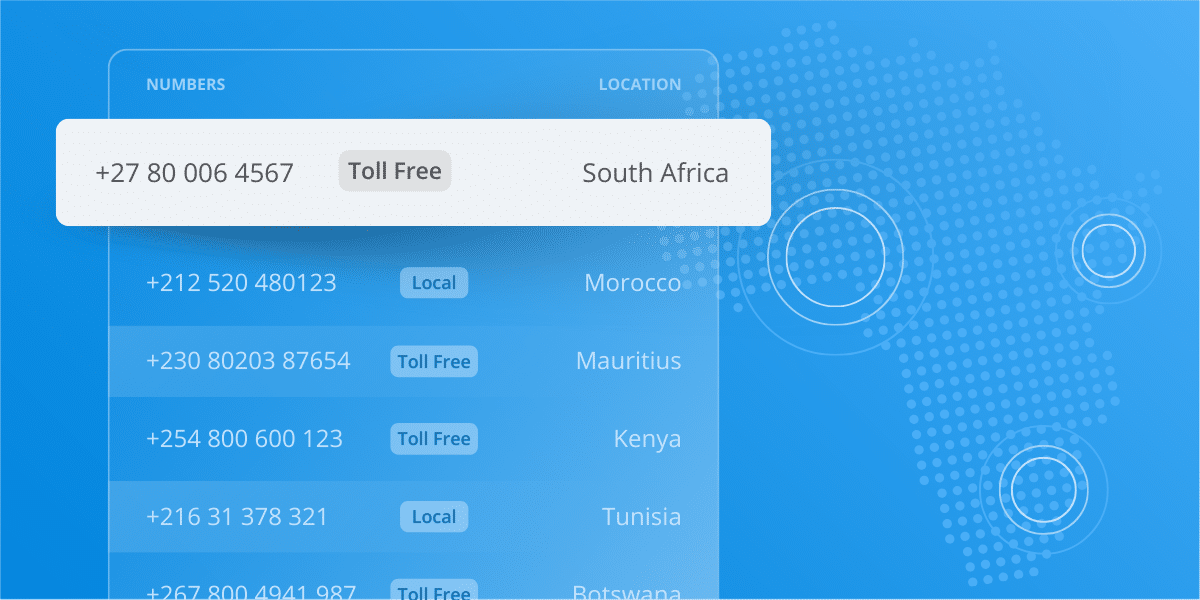
- Can they provide all number types you need (local DIDs, toll-free, mobile)?
- How quickly can they provision numbers in each country?
GDP-Weighted Coverage Assessment: When evaluating African coverage, the critical question isn't how many countries a provider claims to serve – it's how well they serve the markets that matter to your business. A provider offering deep inventory and strong carrier relationships in South Africa, Nigeria, Kenya, Egypt, and Morocco often delivers more operational value than one claiming presence across 40 African countries but with limited capabilities where you actually need them.
2. Carrier Vetting: The Hidden Differentiator
The quality of your voice service in Africa directly correlates with your provider's carrier relationships. Direct relationships with Tier 1 African carriers like MTN, Vodacom, and Safaricom mean better quality, faster problem resolution, and more stable service.
Questions to Ask:
- Do you have direct relationships with major African carriers?
- How many intermediaries exist between your platform and the local carrier?
- Who handles relationship management with African carriers?
Red Flag: If a provider can't clearly explain their carrier relationships or uses vague terms like "we work with various partners," you're likely looking at a long supply chain that will complicate troubleshooting.
3. Infrastructure and Technology Architecture
Proximity matters in voice. Data centers in Europe serving African traffic introduce latency, degrading call quality. The best providers maintain infrastructure within or near African markets.
Technical Requirements:
- Data center locations within Africa, the Middle East, and Western Europe
- Full SIP trunking capabilities, not just PSTN forwarding
- Native integration with your CCaaS or UCaaS platforms
- Multiple routing options for critical markets
4. Ongoing Testing and Proactive Monitoring
African voice deployments don't fail at launch; they deteriorate over time without proper monitoring. In markets where a single carrier outage can isolate entire business districts, continuous testing and proactive service aren't optional – they're operational necessities that separate successful deployments from expensive failures.
Testing Requirements:
- Continuous number monitoring across all your African markets, not just pre-deployment validation
- Automated testing schedules that catch degradation before customers notice
- Real-time performance tracking of Answer Seizure Ratios, Post-Dial Delay, and call completion rates
- Proactive anomaly detection that identifies issues before they impact your business
- API-driven monitoring integration with your existing operational dashboards
The best providers continuously test numbers, monitor traffic patterns, and investigate anomalies automatically – particularly important in regions where troubleshooting involves multiple time zones, language barriers, and complex carrier relationships.
5. Compliance Documentation
Successfully navigating African telecommunications regulations requires more than a compliance checkbox – it demands ongoing documentation management, local expertise, and proactive regulatory monitoring.
- Written confirmation of regulatory compliance for each country
- Clear documentation of registration requirements
- Porting eligibility and process documentation
The BYOC Alternative: When Traditional Providers Fall Short
Sometimes, the best solution for African coverage isn't finding a better provider – it's keeping your existing local relationships while gaining global platform capabilities. Bring Your Own Carrier (BYOC) strategies are particularly effective in Africa.
When BYOC Makes Sense:
- No Coverage Available: For countries like Gambia or Zimbabwe, where cloud providers have no presence
- Regulatory Requirements: When local regulations require domestic carrier relationships
- Cost Optimization: When local carrier rates significantly beat international provider pricing
How BYOC Works:
Rather than abandoning your existing African carrier relationships, BYOC allows you to connect local carriers to your global voice platform via SIP trunking. You maintain the local relationship and compliance while gaining the management capabilities and analytics of a global platform.
Red Flags: Warning Signs of an Inadequate Provider
- Vague Supply Chain Descriptions: If they can't clearly articulate how they deliver service in specific African countries
- No Documented Compliance Strategy: "We handle compliance" isn't a strategy
- Inability to Explain Carrier Relationships: Reluctance to share this information indicates weak relationships
- Lack of Africa-Specific Expertise: Look for dedicated African teams, not generalists
Implementation Best Practices: Your African Voice Roadmap
Market Prioritization Framework
Your African voice strategy should reflect your business priorities, not generic market rankings. Start by mapping where you actually need coverage based on current operations, customer concentrations, and expansion plans.
The key is aligning provider capabilities with your specific requirements. A provider with excellent service in your Phase 1 markets matters more than one claiming coverage everywhere. Build your deployment strategy around business impact, not coverage maps.
Tier 1 - Must-Have Markets:
- South Africa: Largest economy, most developed infrastructure
- Nigeria: Massive population, rapid digital adoption
- Kenya: East African hub, strong technology sector
- Egypt: North African gateway, strategic location
Tier 2 - Important Opportunities:
- Ghana, Tanzania, Morocco, Uganda
Tier 3 - Opportunistic Approach:
- Smaller markets with specific business cases
- Countries where BYOC makes more sense than direct coverage
Risk Management Strategy
- Start with High-GDP Markets: Begin deployment in markets with the best infrastructure and highest business value.
- Build Redundancy Where Possible: In critical markets, maintain multiple provider relationships.
- Maintain Ongoing Compliance Monitoring: Establish quarterly reviews of compliance requirements.
The Path Forward: Making Your Decision
Choosing a voice provider for African operations is a strategic choice that impacts your ability to serve customers, expand operations, and compete effectively across the continent.
The complexity of African voice operations demands more than traditional carrier services. You need a partner who combines deep African expertise with global platform capabilities, direct carrier relationships with flexible BYOC options, and the transparency to show you exactly how your voice service is delivered.
In Africa, perfect coverage doesn't exist. The goal isn't to find a provider who claims to do everything everywhere, but one who excels in your priority markets and offers creative solutions for the rest.
The enterprises succeeding in Africa aren't those waiting for perfect infrastructure – they're the ones who understand the landscape's complexity and choose partners equipped to navigate it. With the right provider and strategy, African markets offer unprecedented opportunity for growth.
Ready to explore your African voice options? Connect with our team, who've spent decades solving these exact challenges for Fortune 500 companies. Whether you need coverage in one country or across the continent, we'll develop a strategy that aligns your business priorities with African market realities.

You Might Also Be Interested in
Security Theater vs. Real Voice Security: What Enterprises Actually Need to Protect


Need Help Getting US Phone Numbers?
We're here to help! Contact us today so we can help find the right business phone number for you.