
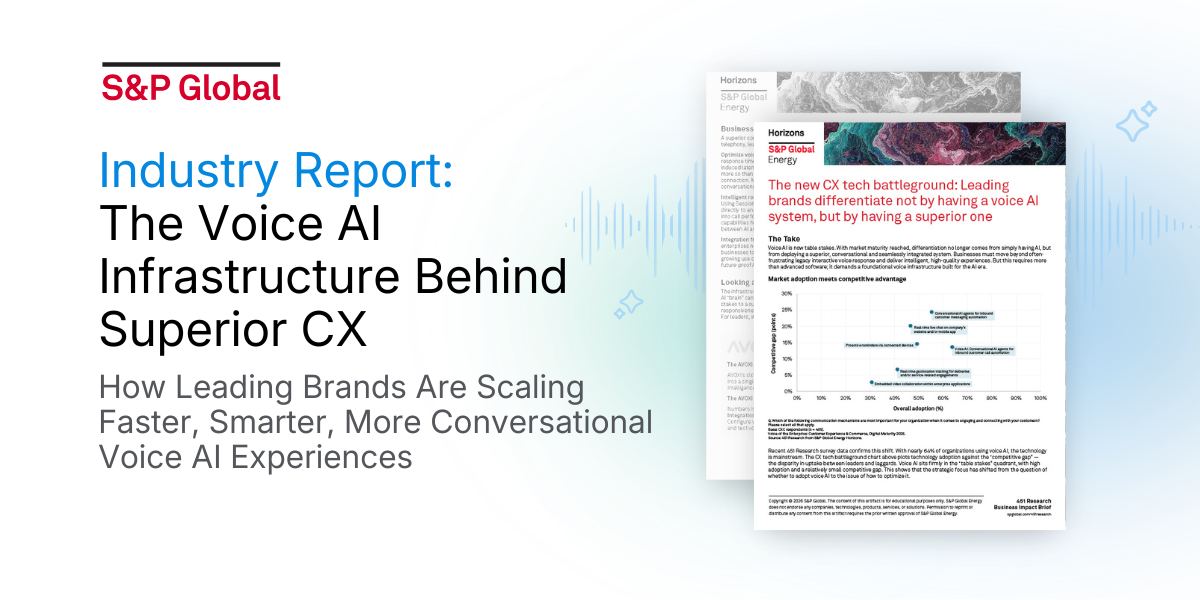
Enterprises hear lots of talk about "AI phone systems," but much of the conversation conflates true innovation with everyday automation. As more providers promote AI-driven tools, the line between marketing and measurable value continues to blur.
The numbers tell the real story: While McKinsey found that 65% of organizations used generative AI in 2024, the Boston Consulting Group reported that only 26% translate their usage into measurable business outcomes. This misalignment partly stems from companies overlooking what makes AI voice work: the reliable global infrastructure that runs underneath it.
Leaders want clarity on what AI can genuinely improve—and what it still depends on. This guide explains what an "AI phone system" should deliver and how enterprises can design intelligent voice experiences that work reliably in the real world.
Key takeaways
- AI phone systems enhance traditional voice infrastructure by incorporating intelligent features such as call routing, analytics, and real-time diagnostics.
- Enterprises leverage these tools to improve responsiveness, minimize costs, and maintain consistent customer experiences across regions.
- The best systems balance automation and human oversight, ensuring reliability, compliance, and clarity at scale.
- AI features, such as conversational IVR, sentiment analysis, and predictive scaling, only perform well when supported by a strong global VoIP foundation.
- AVOXI’s AI-ready voice platform provides the secure, scalable infrastructure that enables these systems to operate reliably across markets and communication platforms.
What is an AI phone system in telecom?
An AI phone system uses artificial intelligence to manage, route, and analyze phone calls. It builds on traditional telephony by adding capabilities like speech recognition and natural language processing to make conversations clearer, faster, and more efficient.
In telecom, AI doesn’t replace core voice infrastructure—it enhances it. Intelligent automation identifies caller intent, directs calls to the right resource, and provides agents with real-time insights. These improvements only work when supported by a strong global network that ensures every call is stable and audible.
Specialized enterprise voice providers can deliver that network layer, complete with Session Initiation Protocol (SIP) connectivity and carrier coverage across regions. AVOXI delivers this foundation, ensuring AI systems perform consistently worldwide and maintain call quality, compliance, and reliability with every customer interaction.
➜ To explore practical ways to strengthen global voice reliability, read the best practices for managing global voice.
Top 5 AI phone systems
The market for AI-powered voice platforms continues to grow, and each provider takes a distinct approach to this technology. When you know how these platforms compare, you can make an informed decision, ensuring the system’s capabilities align directly with your enterprise-level needs. Let's take a look at the best cloud-based AI phone solutions.
1. Dialpad
Dialpad combines unified communications with built-in AI voice intelligence. It focuses on transcriptions, summaries, and real-time coaching to help teams improve their performance on every call.
[Image: Dialpad interface showing a live call transcription with an Enable AI toggle option (Source: Dialpad documentation)]
Key features:
- Instant transcription: Capture conversations as they happen and generate accurate text records.
- Call summaries: Produce immediate recaps and highlight next steps after each conversation.
- Live coaching: Deliver on-screen prompts that guide agents during active calls.
- Quality analysis: Automatically score phone calls and flag areas that need improvement.
2. Ringover
Ringover is an AI business phone system that merges voice, SMS, and analytics. Its AI features streamline call handling and make reporting more intelligent.
[Image: Ringover CRM integration dashboard showing a customer record with their SMS and call history (Source: SoftwareAdvice's Ringover review page)]
Key features:
- Conversation transcription: Convert spoken words into searchable, organized text records.
- AI summaries and insights: Generate quick takeaways and analyze conversation outcomes.
- Intelligent routing: Direct callers to the right agent or department based on real-time data and context.
- Omnichannel integration: Unify voice and messaging in one connected workspace.
3. Goodcall
Goodcall offers a custom-trained voice AI agent that can autonomously handle inbound calls. It targets small businesses that want to answer customers faster without hiring additional staff.
[Image: Goodcall dashboard showing customer calls, appointment links, and call flow analytics. (Source: Goodcall)]
Key features:
- Autonomous answering: Instantly respond to incoming calls with conversational AI.
- Intent recognition: Identify the caller’s needs and provide tailored responses.
- Human escalation: Transfer complex inquiries to live agents when required.
- Fast deployment: Launch voice agents quickly without technical setup.
4. Emitrr
Emitrr focuses on small and medium-sized businesses (SMBs) that need automation in call management and follow-ups. It leverages AI to improve responsiveness and capture customer details.
[Image: Emitrr dashboard displaying team conversations and a contact details panel (Source: Emitrr)]
Key features:
- Auto routing: Receive and redirect inbound calls to the right line or team.
- Voicemail transcription: Convert recorded messages into readable text for quick review.
- Data capture: Automatically extract caller information and log it directly in the system.
- 24/7 availability: Maintain active phone support around the clock, leveraging automated responses.
5. Kore.ai
Kore.ai is an enterprise conversational AI platform that supports both voice and digital channels. Companies can design and manage complex AI interactions from a single environment.
[Image: Kore.ai SmartAssist interface displaying a live customer chat and agent assist panel (Source: Kore.ai)]
Key features:
- Omnichannel design: Build voice and chat agents that work consistently across platforms.
- Custom model training: Train AI with business-specific vocabulary and workflows.
- System integrations: Connect bots to customer relationship management (CRM) platforms, databases, and APIs for end-to-end automation.
- Performance monitoring: Track results and refine models using analytics and feedback.
Key features to look for in an AI phone system
Choosing an AI phone system starts with understanding which capabilities matter most. Enterprise telecom teams need solutions that integrate seamlessly, maintain compliance, and perform reliably across regions.
Key priorities include:
- Conversational intelligence: Ensure the system accurately understands speech and intent.
- Integration flexibility: Connect with Contact Center as a Service (CCaaS), Unified Communications as a Service (UCaaS), and CRM platforms to unify communication and data.
- Intelligent routing: Direct calls by language, location, or behavior to shorten response times.
- Compliance and security: Safeguard call data and meet telecom regulations in every market.
- Performance visibility: Track jitter, latency, and Mean Opinion Score (MOS) for proactive issue resolution.
- Human oversight: Delegate complex or sensitive cases for human review and quality assurance.
With these elements in place, enterprises can turn capabilities into measurable improvements, provided the AI transformation genuinely enhances the core mechanics of enterprise voice.
How AI enhances enterprise voice
AI transforms standard voice operations into adaptive systems that continually improve team performance. It routes calls accurately, maintains call quality, and proactively detects and fixes issues before they can disrupt customers.
Intelligent call routing
AI analyzes caller intent, behavior, and language to direct calls to the right agent or department. This precision reduces wait times and prevents misrouted calls, creating faster and more satisfying customer experiences.
Predictive scaling and resource optimization
Machine learning models forecast call volumes and adjust bandwidth in advance to optimize resource allocation. This proactive allocation maintains stable connections during peak activity, ensuring customers never experience slow or dropped connections.
Continuous monitoring and diagnostics
Automated systems track latency, jitter, and packet loss to preserve call quality. When performance drops, team members receive instant alerts, allowing them to resolve issues before users experience disruption or audio degradation.
Human-like collaboration
AI-powered systems assist human agents—not replace them. The systems manage repetitive tasks and instantly surface key insights, freeing up staff to focus on complex, high-value interactions that strengthen relationships and trust.
Business benefits of AI-enabled voice
AI-enabled voice improves how enterprises communicate across regions. With automation built on a reliable voice foundation, teams cut costs, boost responsiveness, and deliver consistent customer experiences. The benefits below demonstrate how these outcomes translate into measurable impact.
1. Significant cost savings
Automation reduces the cost of maintaining large-scale voice operations. Intelligent routing, transcription, and reporting replace repetitive manual work, allowing smaller teams to handle higher call volumes efficiently. According to IBM’s Global AI Adoption Index, 42% of companies are exploring AI to automate manual and repetitive tasks, directly contributing to operational savings.
2. Enhanced scalability
As businesses expand into new markets, AI systems scale alongside them. Automated voice agents and intelligent routing adjust to changing call volumes and time zones without requiring immediate physical office expansion or localized hiring.
3. Data-driven decision making
AI captures and processes massive amounts of conversation data. These insights help management identify customer trends, monitor agent performance, and refine communication strategies based on real-world evidence rather than intuition alone.
Real-world examples: AI phone systems in action
Enterprises deploy AI for routing, analytics, and customer engagement. To achieve the stability and global reach required for confident scaling, these systems run on reliable SIP trunking and global voice networks provided by specialists like AVOXI.
Appointment scheduling and reminders
Healthcare networks, service firms, and BPOs all use AI schedulers to automate booking management. The system confirms appointments, reschedules them as needed, and sends appointment reminders, reducing no-shows and administrative work while improving the customer experience.
For example, a regional call center can build an AI scheduler on AVOXI's SIP trunking to manage calls across time zones. The AI controls the scheduling logic and communication flow, while AVOXI simultaneously ensures every call connects clearly and compliantly.
Lead qualification and outbound outreach
Sales and marketing teams use AI to reach prospects more efficiently and boost conversion rates. The system initiates calls, screens responses, and then passes qualified leads to human agents to close.
A BPO operator used Synthflow's AI voice agents to handle over 600,000 monthly calls across multiple languages and clients, integrating SIP and CRM systems in 60 days. When paired with AVOXI's global voice coverage, similar deployments maintain clear, compliant connections that scale outreach across markets.
Customer support and FAQ handling
Customer service teams use AI assistants to respond to frequent inquiries such as order tracking, billing updates, or technical troubleshooting. The system resolves them instantly and transfers complex issues to human agents when necessary, ensuring consistent service across all channels.
Proactive updates and status notifications
Enterprises also use AI to stay ahead of customer expectations. Automated notifications provide updates on shipment progress, appointment confirmations, and service alerts, reducing inbound call volume and improving transparency.
What you get with AVOXI's AI-ready voice platform
AI tools depend on a stable, compliant, high-quality Voice over Internet Protocol (VoIP) foundation. AVOXI provides that foundation by enabling enterprises to connect their existing contact center and AI analytics systems to a global network built for performance, transparency, and scalability. Here are the core capabilities AVOXI delivers:
Global SIP and voice coverage
AVOXI delivers enterprise-grade SIP trunking in over 150 countries, providing enterprises with the worldwide reach to run AI-enabled voice applications with clarity and regulatory confidence anywhere. The platform achieves this stability by using multiple number types and redundant routing to ensure consistent uptime and low latency, even during high call volumes.
TrueLocal™ and caller ID management
To ensure high answer rates, AI outbound systems must present a local, recognizable number. AVOXI’s TrueLocal™ feature enables businesses to display two-way local caller IDs across the globe, ensuring calls look familiar to recipients and comply with local regulations.
Proactive monitoring and Call Insights
Enterprises need to know exactly how their voice infrastructure performs. AVOXI’s Call Insights tool provides real-time visibility into MOS, jitter, and latency. This allows technical teams to detect and resolve network-level issues before they impact the performance of AI voice agents or analytics engines.
Flexible platform integrations
AVOXI integrates seamlessly with major CCaaS and UCaaS platforms, including Genesys, NICE, Microsoft Teams, and Zoom. This allows organizations to layer AVOXI’s global voice connectivity underneath their existing communication stacks, ensuring that AI-driven features operate with high-quality audio and consistent reliability across the entire organization.
Design your AI-ready voice strategy with AVOXI
As enterprises deploy AI for routing, analytics, and customer engagement, a dependable global voice foundation becomes even more critical.
AVOXI's cloud-first infrastructure provides that foundation. Whether you're evaluating global voice solutions or managing an existing deployment, AVOXI's platform adapts to your needs. Its globally distributed network, built-in monitoring, and seamless integrations keep enterprises ready for the next generation of AI tools.
Build your AI-ready voice environment today. Request a demo to learn how AVOXI's global network can support your enterprise voice strategy with the clarity, compliance, and reliability your AI solutions need.
FAQ about AI phone systems
Does AVOXI's AI system replace my UCaaS provider?
No. AVOXI strengthens your existing UCaaS provider—it doesn’t replace it. AVOXI serves as the global voice layer, powering reliable connectivity, compliance, and call quality for platforms like Zoom, Microsoft Teams, or Genesys, ensuring every call connects clearly and performs consistently worldwide.
Can AI reduce missed calls?
Yes. When paired with a reliable global voice network, AI automatically routes calls, triggers follow-ups, and sends reminders to minimize missed connections. AVOXI ensures that AI systems operate accurately and deliver every customer interaction in real time, thanks to stable SIP routes and clear audio paths.
Does AVOXI's AI system integrate with Genesys, NICE, or Teams?
Yes. AVOXI integrates seamlessly with major CCaaS and UCaaS platforms, including Genesys, NICE, Microsoft Teams, Five9, Amazon Connect, and Zoom. You get to keep your existing communication tools while augmenting them with AVOXI's global SIP coverage, proactive monitoring, and analytics.
Does AVOXI offer an AI phone system?
No. AVOXI doesn’t sell an AI phone system or virtual agent software. AVOXI provides the AI-ready voice infrastructure that supports those tools. Its global SIP network, analytics, and diagnostics ensure that AI voice assistants, call analytics platforms, and CCaaS solutions operate with reliable, compliant, high-quality voice connectivity in every market.

You Might Also Be Interested in



Need Help Getting US Phone Numbers?
We're here to help! Contact us today so we can help find the right business phone number for you.