

6 Best Cloud Unified Communications Providers (2026)

Cloud unified communications is now the default way for global enterprises to run voice, video, and collaboration. If you own telecom or voice strategy, you're under pressure to support distributed teams, integrate with core communication systems, and keep call quality high in every region.
The cloud unified communications solutions in this guide help you do that—if you choose and implement them with global voice requirements in mind.
Need to enhance your cloud unified communications?
AVOXI can support compliance efforts, streamline voice systems, and place relevant analytics all in one intuitive dashboard.
Book a Demo
What Is Cloud Unified Communications in 2026?
Cloud unified communications brings calling, video meetings, messaging, and collaboration tools together in a software platform delivered from the cloud instead of on-premises hardware. Instead of relying on physical infrastructure, users access everything through web, desktop, or mobile apps, while the provider maintains the backend infrastructure and scales resources up or down as demand changes.
In the past, legacy UC platforms typically required PBXs, SBCs, and dedicated servers in each region, often alongside separate vendors for conferencing and messaging. Cloud-based unified communications replaces that stack with geo-distributed data centers, global SIP connectivity, and API-based integrations.
As a result, organizations can support hybrid or remote work, add sites or users quickly, and benefit from continuous feature updates—without managing hardware refresh cycles or carrier contracts in every country.
For global enterprises, the real shift is that voice, video, and messaging now share one control plane. That makes it much easier to apply consistent security policies, enforce compliance, and get a single view of performance across markets, while still integrating with your existing PBX, contact center, and CRM systems where needed.
6 Best Cloud Unified Communications Providers (2026)
The six platforms below are widely adopted for enterprise cloud unified communications. Each offers strong collaboration features; the differences show up in how they handle global voice, integrations, and hybrid environments. In many cases, you'll get the best outcome by pairing one of these Unified Communications as a Service (UCaaS) platforms with a specialized global voice provider like AVOXI to close coverage, routing, or compliance gaps.
1. Webex Suite
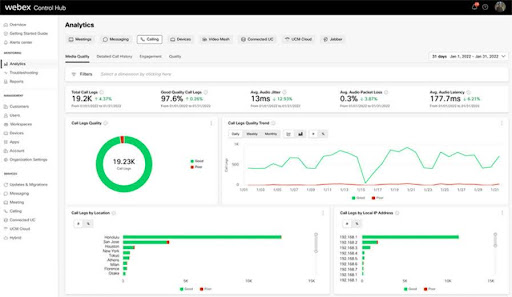
Webex Suite is Cisco's full-stack cloud unified communications platform, built for enterprises that need strong security, flexible deployment, and mature voice capabilities across regions.
Selected Features:
- Enterprise calling: Webex Calling offers cloud PBX with dedicated instances based on Cisco Unified Communications Manager (CUCM), so you can keep Cisco endpoints and dial plans while moving to the cloud.
- Hybrid options: Webex supports hybrid calling and survivable branch appliances, letting you keep on-premises call control in sensitive sites and use cloud services elsewhere.
- AI-assisted collaboration: Webex Assistant adds captions, translation, and meeting summaries, helping global teams work across languages and time zones.
Limitations:
Licensing and design for hybrid deployments can be complex, and you'll usually need Cisco expertise to configure CUCM, SBCs, and regional instances. Webex also covers many—but not all—countries natively, so you may still rely on a global voice partner for certain markets.
2. RingCentral
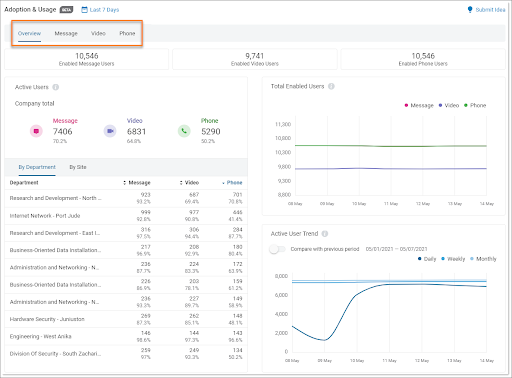
RingCentral is a telephony-focused cloud unified communications platform with strong global reach and a large integration ecosystem, well suited to enterprises that put voice at the center of their stack.
Selected Features:
- Global numbers and PSTN: Numbers in 110+ countries and local PSTN connectivity in dozens of markets help you support distributed teams without managing local carriers yourself.
- Advanced voice features: Call queues, monitoring, hot desking, and real-time QoS analytics give you control over voice quality and operations.
- Integrations and APIs: Native integrations with Salesforce, Microsoft 365, Google Workspace, and others, plus open APIs, make it easier to embed calling into your existing workflows.
Limitations:
Pricing can become intricate once you layer in international minutes, SMS/MMS, and storage, and you may still see coverage or quality gaps in certain countries. Many enterprises pair RingCentral with AVOXI SIP trunking or virtual numbers to standardize global voice routing and reduce international costs.
3. 8x8
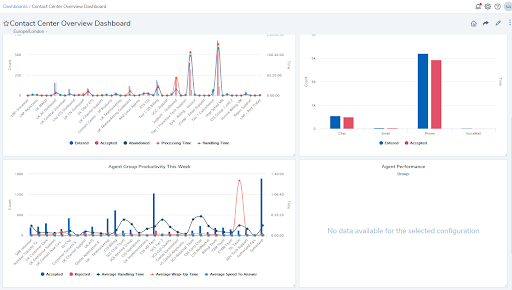
8x8 combines cloud unified communications and contact center capabilities in a single platform, with AI features that support voice-led customer interactions across channels.
Selected Features:
- UC + CC in one stack: Voice, video, chat, and contact center share one platform, simplifying management and reporting if you run global support or sales teams.
- AI assistance: Tools like Smart Assist provide real-time guidance, post-call summaries, and sentiment analysis to help agents handle complex calls more efficiently.
- Global footprint: International numbering and centralized management support multi-country deployments without separate contact center vendors.
Limitations:
The interface can feel heavy compared with lighter UCaaS tools, and some advanced CX features require higher-tier plans. Enterprises with large or highly regulated footprints often still bring in AVOXI for deeper number coverage and more flexible SIP connectivity.
4. Zoom
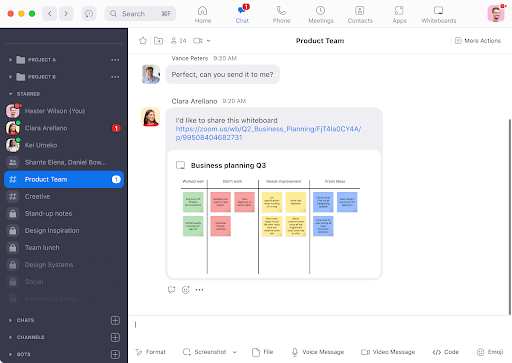
Zoom has moved from "video meetings only" to a broader cloud unified communications platform that combines meetings, Zoom Phone, messaging, and contact center features.
Selected Features:
- Zoom Phone: Cloud telephony with global calling plans, SBC integration, and support for SIP/H.323 room systems lets you fold legacy voice into a modern platform.
- AI Companion: Built-in AI supports transcription, summaries, and suggested actions across meetings and calls, reducing manual note-taking and follow-up work.
- Contact center options: Zoom Contact Center adds voice routing, analytics, and digital channels for organizations that want a single vendor for internal and external communications.
Limitations:
Zoom's core strengths remain video and meetings; more specialized telephony or regulatory scenarios may require extra design work. Many enterprises use AVOXI virtual phone numbers with Zoom to expand country coverage, improve local caller ID, and manage complex international routing.
5. Nextiva
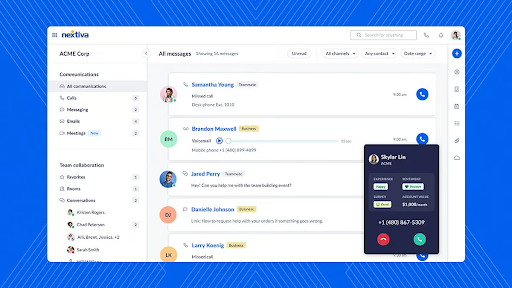
Nextiva offers an all-in-one cloud communications platform focused on reliability and customer experience, with voice, video, messaging, and contact center tools under one brand.
Selected Features:
- Business VoIP and PBX: Auto attendants, IVR, queues, recording, and analytics cover the core voice features most enterprises need.
- Omnichannel options: Higher tiers add SMS, web chat, and AI-driven contact center tools for more advanced use cases.
- Ease of use: A straightforward interface and strong support make Nextiva attractive if you want to simplify operations for distributed teams.
Limitations:
Some enterprise-grade analytics, AI features, and SSO are only available on upper tiers, and public detail on specific country coverage is limited. If you're expanding aggressively outside North America, you may still want AVOXI for broader numbering and regulatory coverage.
6. GoTo Connect
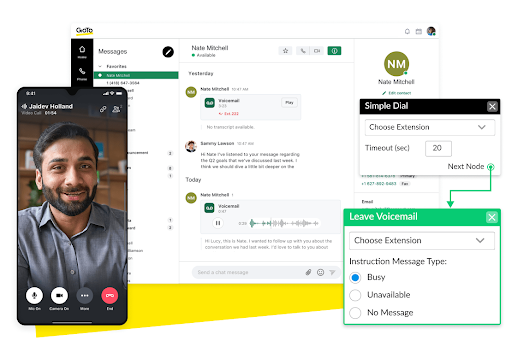
GoTo Connect is a cloud unified communications platform aimed at multi-site businesses that want voice, video, messaging, and basic contact center features without heavy IT lift.
Selected Features:
- Voice and PBX features: Auto attendants, ring groups, queues, recording, and E911 support give you a complete cloud phone system for most offices.
- Omnichannel inbox: Email, SMS/MMS, WhatsApp, and team chat feed into a unified inbox so agents can work from one screen.
- Admin simplicity: Web-based tools make it easy to configure call flows, prompts, and users without deep telecom expertise.
Limitations:
Very large or highly specialized contact centers may outgrow native analytics and routing options. Enterprises often combine GoTo Connect with a global carrier like AVOXI to standardize numbering, improve call quality in harder-to-reach markets, and keep international costs under control.
Essential Cloud Unified Communications Features
Once you narrow your shortlist, validate that each platform meets the demands of global voice operations, not just internal collaboration. These six feature areas are the ones to scrutinize most closely.
1. Security and Compliance
Your UC stack carries customer data, internal discussions, and sometimes financial or health information. Leading providers offer end-to-end encryption, multi-factor authentication, and certifications such as GDPR, HIPAA, and SOC 2.
IBM's 2025 Cost of a Data Breach report puts the average incident at $4.44 million, so weak controls quickly turn into real exposure. Confirm how voice, video, and recordings are encrypted, how access is managed, and whether the provider supports data residency and retention policies that match your regulatory obligations in each market.
2. Scalability and Global Reliability
Cloud unified communications should grow with you—global data centers, redundant architecture, and SIP connectivity that handles surges without degraded quality. According to a 2026 report from Mordor Intelligence, cloud deployments accounted for about 66% of UC&C market share in 2025. Ask each vendor where their media and signaling nodes sit, how failover works between regions, and what tools you'll have to monitor latency, jitter, and packet loss in real time.
3. SLAs, Uptime, and Network Performance
Most providers advertise "four nines" of uptime, but look at what's financially backed in the SLA and how outage credits are triggered. For global enterprises, pressure-test scenarios with your vendors: regional data center failures, carrier issues in key countries, or large spikes in inbound volume. The more transparent the provider is about design and monitoring, the easier it is to manage risk.
4. Integrations with Enterprise Software
At a minimum, expect solid integrations to CRM platforms (Salesforce, Microsoft Dynamics, HubSpot), productivity suites (Microsoft 365, Google Workspace), and ITSM or helpdesk tools. Test how deeply those integrations work in practice—calls auto-logged with recordings and notes, click-to-dial from CRM records, and unified analytics across communication channels without exporting to spreadsheets.
5. Compatibility with Existing IT and Telecom Infrastructure
Few enterprises can forklift their entire voice estate into the cloud in one move. Check how well each platform supports hybrid deployments, Bring Your Own Carrier (BYOC), and SIP trunking to your existing PBX or SBCs. The more flexible the platform is in connecting to your current environment, the less risky and expensive your migration will be.
6. AI-Powered Call Routing and Analytics
Look for AI features that directly improve operational outcomes: intelligent routing based on skills and context, live transcription, sentiment detection, and summaries that reduce wrap-up time. Ask vendors to demonstrate using your scenarios—international support queues or regional sales teams—so you can see whether their AI actually improves answer rates and resolution times.
Cloud Unified Communications Pricing and TCO
Total cost of ownership (TCO) is where cloud unified communications decisions either pay off or erode your budget, especially once you factor in enterprise voice needs.
Most platforms use per-user subscription pricing, sometimes with usage-based charges for international calling, SMS, or APIs, so get a clear breakdown of license tiers, what's included at each level, and how costs change when you add countries, contact center seats, or advanced analytics.
Beyond licenses, budget for:
- Onboarding and professional services
- Network upgrades to support real-time media
- Compliance-driven storage of recordings
- Dedicated support tiers
- International numbers and minutes, as local DIDs, toll-free numbers, and outbound calling rates vary widely by country and provider
Model three to five years of costs under realistic scenarios—headcount growth, geographic expansion, and seasonal volume spikes. Include any third-party voice services such as AVOXI for global numbering or SIP trunking so you can see complete communications spend, not just UCaaS license fees.
How to Evaluate Cloud Unified Communications Providers
A structured evaluation framework helps you compare providers without getting lost in feature checklists. One simple method you can employ is to score each vendor 1–5 across a consistent set of criteria, then weight each category based on your priorities.
For global enterprises, useful categories include:
- Global number coverage
- Voice quality and SLAs
- Security and compliance
- Integration depth
- Analytics and AI
- Support model
- Overall total cost of ownership (TCO)
Assign weights—for example, 25% for global voice, 20% for integrations, 20% for security, 20% for TCO, and 15% for AI and analytics—then calculate those weighted scores.
During technical validation, ask vendors to demonstrate call flows that mirror your reality: transfers between regions, CRM screen pops, failover between SIP trunks, or emergency calling in multiple countries.
Build decision checkpoints into your business processes, such as a shortlist, proof of concept, and pilot, so you can exit early if a provider can't meet a must-have requirement.
Cloud Unified Communications Implementation Strategy
A phased strategy lets you protect user experience while you modernize voice and collaboration.
1. Assess Current Infrastructure and Requirements
Map your current environment, taking note of PBXs, SIP trunks, numbers per country, call flows, and integrations with tools like Salesforce or ServiceNow. Document call volumes, concurrency, and which regions handle the most critical traffic. Capture regulatory requirements around recording, retention, and emergency calling in each jurisdiction.
This assessment clarifies what needs to move, what can be retired, and where you'll rely on a global voice partner like AVOXI to fill gaps.
2. Develop Integration and Migration Roadmap
Decide which sites or business units move first, how you'll handle number porting, and where you'll use AVOXI SIP trunking or virtual numbers instead of native UCaaS telephony. Define success metrics for each phase—call quality scores, answer rates, handle times, or cost savings. Align timelines with change management and training plans to reduce friction for users moving away from familiar communication tools.
3. Execute Pilot Testing and Validation
Run a pilot with a representative mix of users across regions, roles, and network conditions. Validate inbound and outbound call flows, routing logic, integration behavior, and call quality under real workloads. Include failover tests and verify that analytics give you the visibility you need. Use pilot feedback to refine configurations, update training materials, and lock in deployment standards.
4. Scale and Optimize Performance
Roll out in waves. Train end users, admins, and supervisors on features relevant to their roles, and monitor KPIs closely, like uptime, MOS scores, answer rates, transfer rates, and international call costs. Then adjust routing, carrier selection, or capacity where you see friction. Also, revisit license tiers, global numbering strategy, and AI features regularly so your environment keeps pace with how your business evolves.
How AVOXI Enhances Cloud Unified Communications
Most UCaaS tools excel at meetings, messaging, and basic telephony. Where they often struggle is consistent external voice performance, coverage, and compliance across dozens of countries. AVOXI fills those gaps as your dedicated global voice infrastructure partner.
Limitations of UCaaS for Global Businesses
Even strong cloud unified communications providers have constraints. Native number coverage is often focused on priority markets, leaving you to source DIDs and toll-free numbers elsewhere. International routing can favor cost over quality in some regions, creating jitter or dropped phone calls for high-value customer relationships.
UCaaS analytics usually don't tell you which carrier hop is failing or why a specific country's answer rates have dropped. You still have to navigate country-by-country regulations for number provisioning, KYC, emergency services, and call recording, and these challenges don't disappear when you choose a UCaaS provider.
How AVOXI Improves UCaaS
AVOXI connects your cloud unified communications platform to a purpose-built global voice network. You get virtual numbers in 150+ countries, including local, toll-free, mobile, and UIFN, that meet in-country regulations, terminating into your UCaaS solution via SIP trunking, direct routing, or certified integrations.
Advanced IVR and intelligent call routing let you direct calls based on time zone, language, geography, or business rules, often going beyond what UCaaS routing engines support. Real-time dashboards and proactive monitoring give you visibility into call quality and carrier performance before issues impact customer engagement or revenue.
Cost Benefits with AVOXI
Consolidating international voice with AVOXI instead of buying numbers and minutes piecemeal lowers total communication costs and simplifies operations. Optimized routing and local breakout reduce per-minute spend compared with routing all calls through a UCaaS provider's default paths.
As you refine your cloud unified communications roadmap, AVOXI can sit beneath your chosen UCaaS solution and contact center, giving you the global voice reach, control, and economics you need—without disrupting the collaboration tools your teams rely on.
Explore AVOXI's global cloud voice capabilities and map them against your 2026 connectivity plans. To get a closer look at how it works, schedule a demo and talk directly with a member of our team.
FAQs about Cloud Unified Communications
Cloud unified communications is a full platform that combines VoIP calling with video meetings, messaging, and collaboration tools, all managed in the cloud. VoIP on its own just replaces traditional phone lines with internet-based calling. When you choose cloud unified communications, you're standardizing voice, video, and messaging under one provider instead of managing separate tools.