
Automated Outbound IVR: How It Works, Use Cases & Benefits (2026)
Automated outbound IVR is often sold as a “smart automation” feature. In practice, it lives or dies on the less glamorous parts of your stack: carrier routing, number strategy, answer rate management, and how all of that ties into your CCaaS and CRMs. If you’ve ever launched a campaign that looked great in a flow chart but crashed into spam labels, one-way audio, or angry customers, you’ve felt this gap.
Outbound IVR adoption is accelerating because you’re being pushed to be more proactive—think fraud alerts, delivery updates, payment reminders, outage notifications, callback orchestration, SLA commitments. The answer to this tension is simple, however. Successful cloud IVR, at its core, is about whether your underlying voice platform, routing logic, and data integrations are built to support this at enterprise scale.
This guide walks through how automated outbound IVR actually works, when it makes sense to use it, how to design it for answer rates and voice quality, what can go wrong, and what you should demand from your voice platform before you turn it on globally.
Key Takeaways
Here are the core points you should keep in mind as you evaluate or redesign automated outbound IVR for your call center.
- Outbound IVR performance is driven more by your voice infrastructure, routing intelligence, and number strategy than by scripts or prompt design.
- Automated outbound IVR is best suited for structured, time-sensitive interactions where you can keep flows simple and escalation paths clear.
- Answer rates, audio quality, and spam labeling are operational KPIs you must design for, not afterthought metrics you look at post-launch.
- The “right” automated outbound IVR platform gives you global coverage, routing and caller ID control, diagnostics, and tight CCaaS integration without locking you into a single carrier or stack.
What is Automated Outbound IVR?
Automated outbound IVR (interactive voice response) is more than a dialer with a prerecorded message. It’s a coordinated system that listens for events, decides who to call, places calls through your voice network, runs an IVR flow, and hands off to agents or other systems when needed.
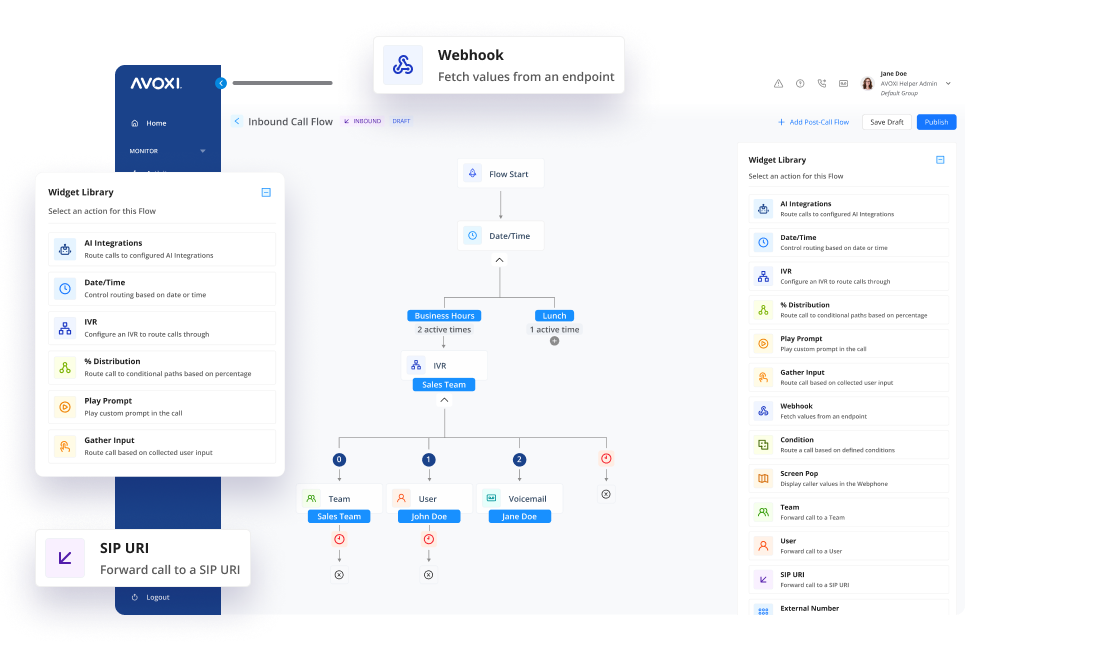
At an architectural level, a typical automated outbound IVR call flow looks like this:
- Trigger source: A business event (e.g., fraud alert, order shipped, ticket updated) or a scheduled job (e.g., tomorrow’s appointment reminders) fires from your CRM, billing system, or application.
- Orchestration logic: A workflow engine or campaign manager decides who to contact, when, on which number, under which rules (time-of-day, consent, throttling, retries, etc.).
- Outbound call initiation: The system initiates calls either via SIP (through your carrier or cloud voice provider) or via an API that your carrier/voice platform exposes.
- IVR application: Once the call is answered, an IVR application plays prompts, captures DTMF or speech input, and executes actions (e.g., confirm appointment, take a payment, trigger a callback, transfer to an agent).
- Voice layer and routing: Behind the scenes, your voice platform handles call setup, routing to the right regional carriers, codec negotiation, and failover if routes or carriers degrade.
- Data and analytics: Events from the call (answer/disposition, choices in the IVR, transfers, failures) are pushed back into your CRM, data warehouse, or reporting tools.
When this is all wired well, you get proactive engagement with high answer rates and predictable customer experiences. When it’s not, you see spikes of failed calls, inconsistent audio, or regulatory risk, no matter how polished your IVR tree looks.
How Does Automated Outbound IVR Work?
Most automated outbound IVR programs fall into two trigger models: event-driven and scheduled campaigns. Each has very different implications for your telecom design and controls.
Event-Driven Outbound IVR
Event-driven outbound IVR routes calls in near real time based on specific events in your systems. Typical examples include:
- Online fraud alerts that require immediate customer verification
- Delivery status changes, like “out for delivery” or “delivery failed”
- Service outages or incidents affecting specific regions, accounts, or services
- High-risk account changes, such as password resets or profile updates
With event-driven models, the complexity lives in call volume handling and prioritization. A fraud incident or regional outage can generate a large call spike to a specific geography in seconds. You need:
- Concurrency controls so you don’t overwhelm carrier trunks or agents when transfers occur
- Burst management and rate limiting per region, carrier, or number range
- Real-time routing decisions if a carrier path or region degrades while a wave of calls is in progress
- Time-zone and SLA awareness to decide whether an event waits until local business hours or must be pushed immediately
Scheduled Outbound IVR
Scheduled outbound IVR campaigns run on a defined cadence. Common use cases include:
- Appointment reminders and confirmations for healthcare, field service, or professional services
- Renewal notifications for subscriptions, contracts, or warranties
- Payment or account balance reminders with simple self-service payment flows
- Policy or regulatory notifications that must be delivered by a certain date
Scheduled campaigns put pressure on your platform’s ability to handle sustained outbound volume while respecting local regulations and customer preferences. You’ll need:
- Time-zone-aware scheduling that avoids early-morning or late-night calls in each region
- Configurable retry logic that varies by campaign type, customer value, and regulation
- Volume pacing that aligns calls with agent availability when transfers are part of the flow
- Capacity planning across SIP trunks, carriers, and CCaaS queues
Both models are valid. The key is designing your telecom and routing layer so you can support both without constant manual reconfiguration.
SIP, APIs, and CCaaS Integration Models
How you connect automated outbound IVR into your existing CCaaS and carrier ecosystem has a major impact on control, quality, and observability.
In the SIP-based outbound calling model, your IVR or campaign engine initiates calls over SIP trunks through a cloud voice provider or directly with carriers. You get:
- Direct control over routing policies, including failover rules and carrier preferences by region
- Consistent handling of caller ID and number reputation across multiple IVR and CCaaS platforms
- Centralized voice quality monitoring and diagnostics at the carrier-agnostic voice layer
With API-triggered IVR calls, your applications hit a voice platform’s API to initiate outbound IVR calls, passing parameters like destination number, caller ID, and which IVR flow to run. This approach is useful when:
- Your trigger systems are already event-driven and API-first
- You need to spin up or adjust campaigns programmatically based on business logic
- You want to standardize outbound calling across multiple CCaaS or PBX environments
CCaaS-native vs. BYOC (Bring Your Own Carrier) becomes a factor because most CCaaS platforms offer some outbound IVR or campaign capabilities. They’re convenient, but they typically:
- Rely on limited or opaque carrier relationships in certain countries
- Offer less granular control over routing paths, caller ID behavior, and local carrier selection
- Provide voice quality metrics that stop at the platform edge, not across the full call path
With a BYOC, carrier-agnostic voice layer, you can keep using the CCaaS tools your teams like while centralizing:
- Number provisioning and management across markets
- Caller ID logic, STIR/SHAKEN registration where applicable, and local number strategies
- Call routing, media handling, and diagnostics across all outbound IVR and live-agent calls
This separation is where platforms like AVOXI typically sit: your CCaaS handles the agent experience and IVR logic while the global voice layer handles the heavy lifting on quality, coverage, routing, and analytics.
When Does Automated Outbound IVR Make Sense for Enterprises?
Automated outbound IVR isn’t the answer for every interaction. It shines when you’re dealing with structured, time-sensitive workflows at scale, and when you can define clear outcomes and escalation paths.
At an enterprise level, you should consider automated outbound IVR when:
- Volume is high enough that live-agent outbound is too slow or expensive
- Timing matters—minutes or hours, not days—such as fraud, outages, or day-before reminders
- The task can be completed with a small number of inputs or confirmations (e.g., yes/no, date selection, simple data verification)
- You have a clear, compliant consent framework and preference management in place
Below are two customer journeys where automated outbound IVR solutions usually deliver the strongest operational impact.
High-Volume Notifications and Alerts
Automated outbound IVR systems are well-suited to high-volume alerts where speed and consistency matter more than deep conversation. Examples include:
- Service disruptions: Notify impacted customers of an outage, provide an ETA, and deflect follow-up calls by sharing status in the IVR.
- Account security: Confirm recent transactions, verify suspicious logins, or walk customers through immediate remediation steps.
- Logistics updates: Confirm delivery windows, handle failed delivery follow-up, or update access instructions.
- Critical compliance notifications: Share required disclosures and record acknowledgment with minimal friction.
In these cases, outbound IVR functionality lets you contact thousands (or millions) of customers in a controlled way, while still providing options to self-serve or escalate to agents when needed. Your main design considerations are timing, answer rates, and clear IVR menus and routing for customers who press “0” or ask for help.
Call Deflection and Callback Orchestration
The other powerful use case is using automated outbound IVR to turn inbound demand into controlled outbound customer engagements.
Typical patterns include:
- Virtual hold and callbacks: Instead of keeping customers on hold, you offer a callback, then use outbound IVR to confirm the customer is ready and route them to the right agent or queue.
- Post-interaction follow-ups: Trigger automated outbound IVR calls to confirm resolution, collect short surveys, or handle next steps after complex customer support cases.
- Queue rebalancing: In multi-region setups, schedule outbound IVR callbacks during off-peak hours or in lower-cost regions while still presenting local caller IDs.
Here, your routing logic and integration with your CCaaS queues are critical. If your voice layer doesn’t understand real-time queue conditions and agent availability, your callback promises will break, and customer trust goes with them.
How To Design Outbound IVR for Answer Rates and Voice Quality
Most guidance on automated outbound IVR focuses on prompt writing and tree design. Those matter, but they won’t help if your calls don’t connect, sound bad, or show up as spam.
From an engineering and operations perspective, the big levers for performance are:
- Your caller ID and number strategy in each region
- How your routing and time-of-day logic is implemented at the voice platform layer
- Visibility into answer rates, call quality, and disposition trends across countries and carriers
If you treat these as first-class design requirements, your IVR flows will have a much better chance of performing well, regardless of which CCaaS or IVR application you use.
Local Caller ID and Number Strategy
Local presence and number reputation are foundational to outbound IVR success.
Key considerations for operationalizing caller ID at scale include:
- Local vs. toll-free vs. mobile: In many markets, customers are more likely to answer local geographic numbers than toll-free or long-distance numbers. In others, mobile-format numbers perform better. You should test this by region and use case.
- Dedicated number pools per use case: Use separate number pools for high-value alerts (e.g., fraud), general notifications, and collections or marketing. This plays a role in protecting the reputation of critical calls and prevents lower-priority traffic from hurting answer rates.
- Consistent caller ID behavior: Ensure your caller ID presentation is stable and predictable. Frequent changes or misaligned CNAM entries (where applicable) erode trust.
- Registration and attestation controls: In markets like the US, make sure your numbers are properly registered, and your calls are authenticated (e.g., STIR/SHAKEN, branded calling where supported) via your voice platform.
- Number performance monitoring: Track answer rates, short calls, and complaint signals at the individual number or group level so you can quickly rotate or retire underperforming DIDs.
A capable global voice platform helps you manage number acquisition, assignment, and performance analytics centrally, rather than leaving it as a manual spreadsheet problem to coordinate across countries and vendors.
Intelligent Routing and Time-of-Day Logic
Your routing and timing strategy has a direct, measurable impact on answer rates and customer experience. Treat it as a product capability, not a one-time configuration in your IVR.
Intelligent routing capabilities to prioritize include:
- Time-zone-aware scheduling: Define allowed calling windows per country or region, taking into account weekends, holidays, and local regulations.
- Dynamic routing by country and carrier: Route outbound IVR calls through the carriers and paths that provide the best performance for each destination, with automatic failover when quality degrades.
- Load-aware callback routing: For callback IVR flows, route based on real-time CCaaS queue data and agent skill availability, not static routes.
- Prioritization and throttling: Give critical alerts (e.g., fraud or safety issues) higher priority and stricter concurrency caps so they’re not competing with lower-priority campaigns.
- Regionalized IVR experiences: Use the same routing platform to steer callers to language-appropriate IVR flows, regional teams, or in-country partners.
When your routing and scheduling live in a centralized, carrier-agnostic voice layer, you can adjust strategy quickly without rebuilding every IVR flow or CCaaS campaign.
Common Outbound IVR Challenges and How to Solve Them
Automated outbound IVR looks straightforward in vendor demos, but the operational reality is more complicated. Being candid about the typical failure modes will help you design around them from day one.
Voice Quality Blind Spots
One of the most frustrating issues is inconsistent audio quality that you can’t easily diagnose. Symptoms include:
- Intermittent one-way audio where customers can’t hear your IVR or agents
- Robotic or choppy audio, especially on mobile networks or across borders
- High call abandonment during IVR playback, even when scripts are solid
These issues often stem from limited visibility across the full call path—your CCaaS, your voice platform, and underlying carriers. To address this, you need:
- Centralized call quality monitoring with metrics like jitter, packet loss, and MOS scores at the call and route level
- Carrier and route analytics so you can identify problematic routes to specific countries or operators and switch away from them
- Configuration consistency (codecs, SIP timers, media anchoring) across CCaaS, SBCs, and carriers to reduce interoperability issues
A global voice platform that exposes detailed call traces and quality metrics is far more useful than one that only tells you whether the call completed.
Over-Automation and Customer Trust Risks
Just because you can automate an outbound touchpoint doesn’t mean you should. Over-automation can undermine trust, especially in sensitive contexts like fraud, healthcare, or collections.
Warning signs include:
- Lengthy IVR flows that ask for too much information or feel intrusive
- Automated calls that trigger shortly after emotionally charged events (e.g., claims denials, account suspensions) without clear context
- Repeated automated outreach after a customer has already engaged with you through another channel
Mitigation strategies:
- Keep automated flows short, with an early option to speak to a person or request a callback in many use cases.
- Align outbound IVR triggers with your broader communication strategy so you’re not duplicating messages across SMS, email, and voice.
- Provide clear identification at the start of the call—who you are, why you’re calling, and what the customer can do next.
Deliverability and Spam Labeling
Even if your calls are legitimate, carriers and devices may label them as “Spam Likely” or block them outright—especially when you’re running high-volume campaigns or using shared numbers.
Common contributors include:
- High short-call rates (e.g., calls under 10–15 seconds) from the same numbers
- Excessive retries to the same customer in a short window
- Using the same caller ID across very different call types (notifications, collections, and sales)
To improve deliverability, your platform and operations should support:
- Per-country call behavior controls for retries, call spacing, and daily limits
- Number rotation rules that balance reputation management with consistency for customers
- Registration and branded calling programs where available, managed centrally instead of ad hoc
- Monitoring for sudden answer rate drops by destination network or number range to catch potential blocking
Compliance and Consent Management
Outbound IVR is heavily regulated in many jurisdictions. Requirements can vary widely across regions and cover consent, calling hours, call recording, and opt-out mechanisms.
To stay on safe ground, you should:
- Centralize consent and contact preferences in your CRM or customer data platform, then enforce them in your orchestration engine and voice platform.
- Segment campaigns by regulation profile (e.g., informational alerts vs. marketing) and apply different rules for each.
- Configure per-country policies for calling windows, maximum attempts, and required disclosures.
- Log evidence of consent and interactions in systems you can audit, not just in the IVR platform.
Your voice layer should make it easy to enforce these policies globally without building a separate stack per country.
Escalation and Fallback Failures
No matter how well you design your IVR, some percentage of customers will need or want a human. If those escalation paths fail, your automated outbound IVR becomes a liability.
Common issues include:
- Transfers to busy or closed queues without clear messaging
- Callback offers that don’t honor the promised time window
- IVR flows that trap customers in loops with no escape hatch
To avoid this, design and test:
- Clear, early escalation options with guardrails so high-risk or high-value customers can reach people quickly
- Queue-aware routing that checks agent availability before offering a live transfer or callback
- Fallback paths for system failures—if your IVR or CCaaS is unavailable, calls should fail gracefully with clear messaging or alternative contact methods
How To Know When Outbound IVR is Failing
Even well-designed automated outbound IVR can drift over time as volumes, regulations, and carrier behavior change. A simple checklist can help you spot problems early.
Review your outbound IVR regularly for these warning signs:
- Answer rates drop suddenly in specific countries, networks, or campaigns without a clear business reason
- Short-call percentages spike, especially calls under 10–15 seconds, suggesting audio problems, spam labeling, or poor scripting
- Repeat call attempts climb because flows aren’t achieving their intended outcome on the first attempt
- Agent escalations increase from customers complaining about confusing IVR calls or “phantom” missed calls
- Opt-out or complaint rates rise, whether via DNC requests, contact center complaints, or social channels
- Inconsistent experience across channels—for example, customers receiving an IVR reminder after they’ve already confirmed via SMS or app
- Support tickets from internal teams about one-way audio, dropped transfers, or unexpected call routing paths
If you see several of these at once, the issue likely sits in your voice infrastructure, number strategy, or routing, not just your IVR script.
How To Choose the Right Platform for Automated Outbound IVR
When you’re already using one or more CCaaS platforms, PBXs, and regional carriers, adding or expanding automated outbound IVR isn’t just a feature decision. It’s a platform decision that affects routing, compliance, and analytics across your entire voice estate.
Use this checklist and our IVR cost analysis to evaluate whether a voice platform is ready to support automated outbound IVR at enterprise scale:
Global Voice Coverage and Numbers
- Can you procure and manage local, toll-free, and mobile-format numbers in the countries you need?
- Does the platform support regional carrier optimization for better quality and deliverability?
Routing Control and Resiliency
- Do you control routing policies by country, carrier, and call type?
- Is there automatic failover across carriers and regions when quality or availability dips?
Caller ID and Reputation Management
- Can you centrally manage caller ID presentation and number pools per use case?
- Does the platform support registration, attestation, and branded calling programs where available?
Compliance and Policy Enforcement
- Can you configure calling windows, attempt limits, and consent rules by country and campaign type?
- Is there a clear audit trail for calls and policy configurations?
Diagnostics and Analytics
- Do you get per-call quality metrics and detailed call traces across the full path?
- Can you slice performance by number, carrier, country, and campaign for continuous optimization?
CCaaS and Application Compatibility
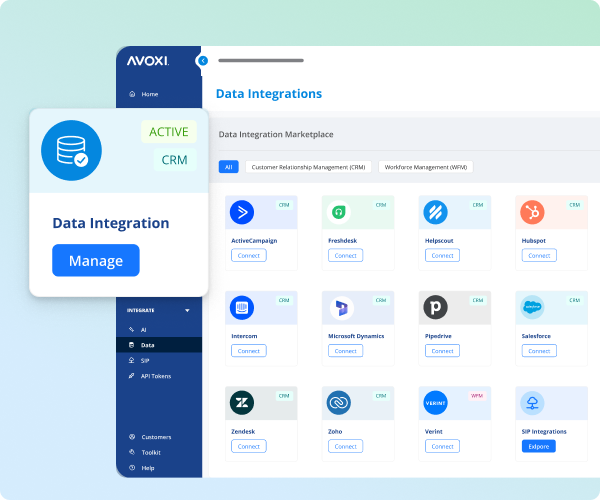
- Does the platform integrate cleanly with your existing CCaaS, CRMs, and workflow tools?
- Can you use BYOC models so your IVR and CCaaS share the same underlying numbers and routing logic?
APIs and Event-Driven Orchestration
- Are there APIs for call initiation, IVR control, and real-time data streaming?
- Can you trigger and manage campaigns programmatically from your own systems?
Operational Support
- Is there a support model that understands global routing, regulations, and enterprise-scale rollouts?
- Can the provider help you design and test new regions or use cases without long lead times?
The more of these boxes you can check, the more confidently you can scale automated outbound IVR without building a patchwork of region-specific solutions.
Automated Outbound IVR That Works at Scale
Automated outbound IVR delivers real value when you treat it as part of your enterprise voice strategy—not as a toggle in a single application. The organizations that succeed are the ones that invest in:
- A global, carrier-agnostic voice layer that owns routing, caller ID, and diagnostics
- Routing and timing intelligence that respects local regulations and customer preferences
- Clear escalation paths into your CCaaS and agent teams when automation isn’t enough
That’s the space where AVOXI focuses: providing the global voice infrastructure, number management, routing control, and analytics that sit under and alongside your IVR and CCaaS tools. You keep the agent experiences and workflows that work for you; AVOXI helps ensure your outbound IVR calls connect, sound clear, and route intelligently—wherever you’re calling.
If you’re looking to modernize or expand your automated outbound IVR, it’s worth starting with your voice foundation. Schedule a free demo to explore how AVOXI’s IVR and call management capabilities support global, automated outbound use cases at scale.
FAQs About Automated Outbound IVR