

AI is reshaping contact center voice, from real-time transcription to autonomous agents handling entire conversations. But the gap between AI ambition and infrastructure reality is where most deployments stall.
AI voice tools underperform when the underlying telephony layer cannot deliver clean, low-latency audio at scale, and enterprises that skip the infrastructure assessment often spend months troubleshooting problems that start below the application layer.
This guide breaks down:
- How AI is changing voice communications and which use cases are driving adoption
- The key performance factors that determine whether your infrastructure is AI-ready
- Warning signs that your current voice setup will hold AI back
- A practical framework for building an AI-ready voice foundation
Struggling to get reliable performance from your AI voice tools?
With AVOXI, you get the low-latency, API-first voice infrastructure that AI applications depend on, backed by a global carrier network across 150+ countries.
How AI Is Changing Voice Communications
Contact center AI has moved well beyond basic IVR menus. The use cases driving adoption today fall into two categories: those that augment human agents and those that operate independently.
Agent-facing applications include real-time transcription that converts live calls to text for coaching, compliance, and record-keeping. Agent assist tools surface relevant knowledge base articles, customer history, and suggested responses during calls. Sentiment analysis monitors tone and language patterns to flag at-risk interactions before they escalate.
Customer-facing applications are evolving faster. Conversational AI voice bots handle routine inquiries, appointment scheduling, and account lookups without human intervention. Intelligent routing uses caller intent, language preference, and historical data to connect customers to the right resource on the first transfer. Caller verification streamlines authentication using voice biometrics and behavioral signals.
The newest category, agentic AI, goes further.
Autonomous voice agents can manage multi-step workflows like processing returns, updating account details, or completing transactions across systems, escalating to a human only when judgment calls arise.
Each of these applications shares a common dependency: They require consistent, high-quality audio delivered with minimal delay. When voice infrastructure cannot meet that standard, transcription accuracy drops, bot responses lag, and sentiment models misread the conversation.
Key Performance Factors for AI-Ready Voice Infrastructure
Before deploying AI tools on top of your voice stack, evaluate whether the foundation can support them. Four factors separate infrastructure that enables AI from infrastructure that undermines it.
Network Architecture and Latency
AI voice applications process audio in real time, so every millisecond of added latency degrades performance. Transcription engines need audio delivered within tight timing windows. Voice bots sound unnatural when round-trip delay exceeds 150-200 milliseconds. Sentiment analysis loses accuracy when packets arrive out of order or with gaps.
The architecture that supports this has three characteristics. Distributed data centers positioned close to where your customers call from reduce the distance audio travels. Intelligent routing algorithms select the lowest-latency path for each call dynamically, rather than relying on static configurations.
Full cloud redundancy eliminates single points of failure that would take AI applications offline alongside the voice layer.
Integration Capabilities
AI tools need access to voice streams, call metadata, and routing controls. If your voice platform treats these as closed systems, every AI deployment becomes a custom integration project.
Evaluate three areas:
- First, does your platform support SIP-based integration with your CCaaS or UCaaS environment without proprietary middleware?
- Second, do programmable voice APIs expose the data your AI tools need, including call records, quality metrics, and real-time event streams?
- Third, can the platform connect to your CRM, helpdesk, and business applications so AI tools can pull customer context into voice interactions?
Solution Flexibility and Vendor Independence
AI tooling is evolving rapidly, and locking into a single vendor's ecosystem limits your ability to adopt better tools as they emerge. AI-ready voice infrastructure lets you select best-of-breed solutions for specific functions, swap out components as the market matures, and modernize incrementally without disrupting your entire communication stack.
This matters because the conversational AI vendor you choose today may not be the leader in 18 months. Your voice layer should be the stable foundation that outlasts any individual AI tool decision.
Data Standardization and Accessibility
AI models need clean, consistent data to function. Fragmented voice infrastructure that spans multiple carriers, regions, and platforms often produces data in incompatible formats, making it difficult for AI tools to aggregate and analyze call information at scale.
Look for centralized voice analytics that provide a unified view across all your numbers and regions. Real-time data access matters because AI applications that rely on batch-processed reports from the previous day cannot support live coaching, real-time routing adjustments, or in-call sentiment analysis.
Standardized data formats across carriers and geographies ensure your AI tools receive consistent inputs regardless of where the call originates.
Warning Signs Your Voice Infrastructure Isn't AI-Ready
If you are evaluating AI voice tools or struggling with an early deployment, these indicators suggest the problem is below the application layer:
High latency or jitter is the most visible symptom. When transcription accuracy fluctuates across regions or voice bots sound stilted in some markets but not others, the root cause is often inconsistent audio delivery rather than a model limitation.
Fragmented carrier relationships across regions create a second problem. Each carrier connection introduces its own codec handling, quality variability, and data format. AI tools trained on consistent audio perform unpredictably when the underlying signal quality changes from call to call.
Lack of API access for AI tool integration forces workarounds. If connecting a new transcription engine or voice bot requires weeks of custom development rather than a standard API call, your infrastructure is creating friction that slows AI adoption.
Inconsistent data formats across markets make it difficult to train, tune, or benchmark AI models. A sentiment analysis tool that receives different metadata schemas from your APAC and EMEA voice providers cannot deliver reliable cross-regional insights.
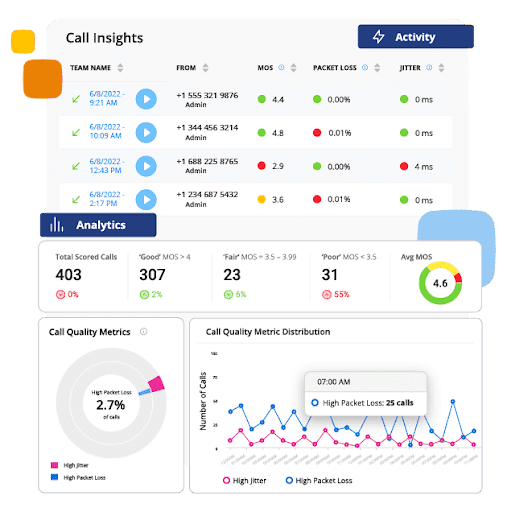
No real-time quality monitoring means you discover AI performance issues from customer complaints rather than dashboards. Without proactive visibility into MOS scores, jitter, and packet loss, you are troubleshooting AI problems after they affect customer experience.
Building an AI-Ready Voice Foundation
Closing the gaps above does not require replacing your entire communication stack at once. It does require treating voice infrastructure as the foundation that AI applications depend on, rather than a utility that just needs to stay on.
- Start with cloud migration as a prerequisite. On-premises PBX and TDM infrastructure cannot provide the API access, elastic scaling, or distributed routing that AI applications require. Moving voice to the cloud is the enabling step for everything that follows.
- Consolidate carrier relationships for consistent quality. Every additional carrier connection introduces variability in audio quality, codec handling, and data formats. Reducing the number of voice providers, ideally to a single cloud voice platform that abstracts carrier complexity, gives AI tools the consistent audio inputs they need to perform reliably across regions.
- Adopt an API-first architecture for AI integration. Your voice platform should expose call events, quality metrics, and routing controls through documented APIs so that connecting a new AI tool is a configuration task, not a development project. AVOXI, for example, provides programmable voice APIs and SIP-based integrations that let enterprises connect AI tools to their voice layer without proprietary middleware or custom builds.
- Build proactive monitoring for AI reliability. AI voice applications are sensitive to quality degradation that human callers might tolerate. Automated number testing, real-time MOS tracking, and anomaly detection catch issues at the infrastructure level before they surface as AI performance problems.
- Scale global reach without scaling complexity. AI voice deployments that work in one region need to expand to others without rebuilding integrations for each market. A platform with coverage across 150+ countries and direct carrier connections simplifies that expansion by providing a single integration point for global voice.
Ready to evaluate whether your voice infrastructure supports your AI roadmap?
AVOXI's team can assess your current setup and identify the gaps between where you are and where your AI tools need you to be.
FAQs About AI-Ready Voice Infrastructure
What does "AI-ready" mean for voice infrastructure?
AI-ready voice infrastructure delivers low-latency, high-fidelity audio through cloud-native architecture with open API access, real-time data streams, and SIP-based integrations. These capabilities let AI tools process voice reliably without custom workarounds or degraded performance.
How does voice quality affect AI performance in contact centers?
Transcription engines, sentiment analysis, and voice bots all depend on clean audio input. Elevated jitter, packet loss, or latency causes misinterpretation, delayed responses, and inaccurate analysis. Consistent MOS scores above 4.0 across regions are a practical benchmark for AI-grade audio.
Can you add AI capabilities without replacing your existing voice platform?
Most enterprises layer AI onto their current stack through SIP integrations and APIs rather than replacing everything at once. The key requirement is that your voice platform provides programmatic access to call streams, routing controls, and quality data so AI tools can connect without proprietary middleware.
What is the first step to assess your voice infrastructure for AI?
Audit your current voice layer for latency consistency, API availability, data format standardization, and real-time quality monitoring. These four areas determine whether AI tools will perform reliably or struggle with infrastructure limitations that no amount of model tuning can fix.

You Might Also Be Interested in

Need Help Getting US Phone Numbers?
We're here to help! Contact us today so we can help find the right business phone number for you.