

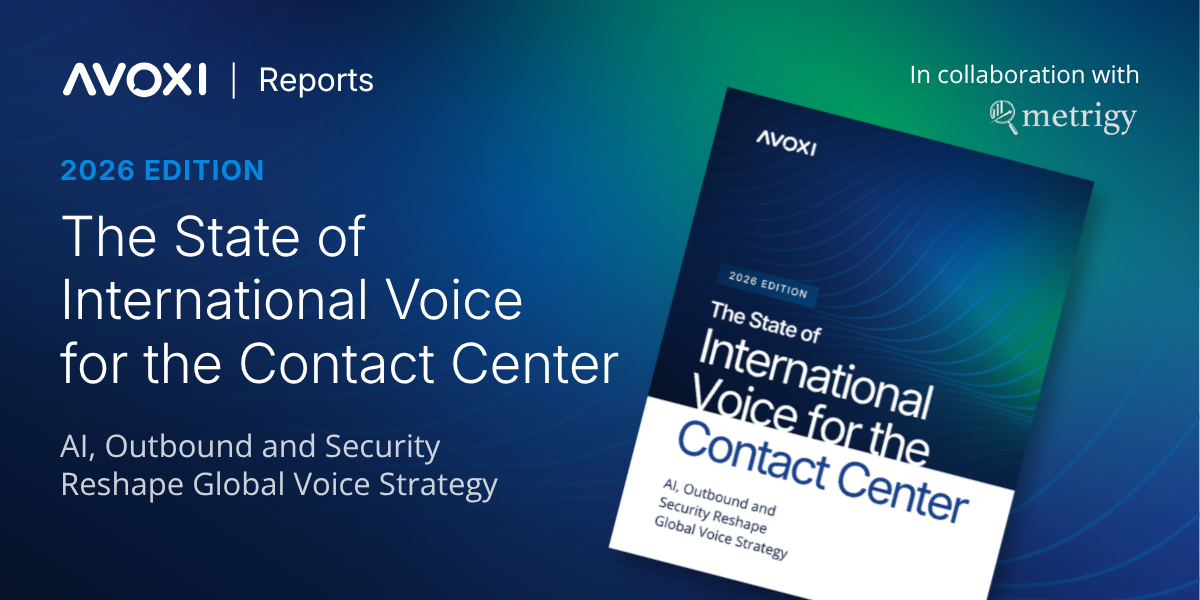
This blog has been updated to reflect new information from our most recent State of International Voice for the Contact Center report.
For global enterprises managing voice communications, a startling reality emerges: nearly all organizations, some 96%, rely on more than one voice provider to serve their customers.
While this fragmentation often evolves naturally through business growth, it creates a complex web of challenges that impacts everything from operational efficiency to the bottom line. As organizations expand globally and customer experience becomes increasingly critical, the hidden costs of managing multiple voice providers are becoming impossible to ignore.
The Current State of Voice Provider Management
The journey to multiple voice providers rarely stems from strategic choice. Instead, it's typically the result of natural business evolution, varying regional requirements, and the complex landscape of modern communications technology. Understanding how organizations arrive at this state is crucial for addressing the challenges it creates.
Business Growth and Evolution
As organizations expand and evolve, their voice provider landscape often grows more complex organically rather than by design. Each stage of growth introduces new requirements and relationships. International expansion typically demands establishing relationships with local carriers to ensure reliable service.
Meanwhile, corporate mergers and acquisitions introduce inherited vendor contracts that must be maintained for business continuity. Even when companies try to streamline their voice services, they often find themselves tethered to legacy systems that remain crucial for specific business functions. Additionally, the realities of global operations often lead to decentralized purchasing decisions, where regional offices select providers based on their immediate local needs rather than global strategic objectives.
Market Complexity
The modern telecommunications landscape presents a maze of options and requirements that companies must navigate. The rapid proliferation of Contact Center as a Service (CCaaS) and Unified Communications as a Service (UCaaS) solutions has created a complex ecosystem of providers, each offering different capabilities and coverage areas. This complexity is further compounded by varying regional carrier requirements and regulations that often necessitate working with local providers.
UCaaS refers to cloud-delivered communication and collaboration tools—voice, video, messaging, and conferencing, bundled into a single subscription platform. UC (Unified Communications) is the broader category that can include on-premises or hybrid deployments of these capabilities. CCaaS, by contrast, is purpose-built for customer-facing contact center operations, with features like IVR, ACD, and agent management layered on top. Understanding the distinction matters: enterprises often run both, sourcing voice services from different providers for each, adding yet another layer of fragmentation.
Service availability can vary dramatically across markets, forcing organizations to piece together coverage through multiple providers to meet their global needs.

Many Businesses Are Using Multiple Providers
According to Metrigy research, 56.5% of companies currently use between two to five providers, while nearly a quarter (23%) manage relationships with more than 15 different voice providers.
The Visibility and Control Challenge
In today's data-driven business environment, lack of visibility and control over voice operations represents one of the most significant yet often overlooked costs of multiple providers. When voice services are fragmented across various platforms and providers, organizations lose the ability to maintain consistent oversight and strategic control of their global voice infrastructure.
Limited Visibility
When voice services are spread across multiple platforms, organizations struggle to maintain comprehensive oversight of their communications infrastructure. Reporting becomes fragmented, with each provider offering different metrics and KPIs that don't align with one another. This misalignment makes it nearly impossible to track global call quality and performance consistently. Perhaps most frustratingly, organizations lose the ability to maintain a single source of truth for voice analytics, making it difficult to make data-driven decisions about their voice services.
- Fragmented reporting across multiple platforms
- Inconsistent metrics and KPIs between providers
- Difficulty tracking global call quality and performance
- No single source of truth for voice analytics
Reduced Control
Managing change across multiple voice providers creates significant operational challenges. Organizations find themselves juggling different security and compliance protocols, making it difficult to maintain consistent standards across their global operations. Standardizing operating procedures becomes an exercise in complexity, as each provider may have different requirements and capabilities. This fragmentation severely limits an organization's ability to implement and enforce global policies effectively, creating potential security vulnerabilities and compliance risks.
- Complex change management across multiple systems
- Inconsistent security and compliance protocols
- Difficult-to-standardize operating procedures
- Limited ability to implement global policies
Direct Financial Impacts
While the obvious costs of multiple voice providers appear in monthly invoices, the true financial impact runs much deeper. Organizations often fail to recognize the cumulative effect of fragmented voice services on their bottom line, leading to significant hidden expenses and missed opportunities for cost optimization.
- Lost volume discounts due to fragmented traffic
- Higher per-minute rates across different carriers
- Redundant services and unused numbers
- Administrative overhead for multiple billing systems
- Hidden costs of managing various contracts and relationships
Real-time cost visibility is another casualty of fragmentation. Without a unified platform, finance and IT teams lack real-time insight into where spend is accumulating, making cost optimization reactive rather than strategic.
The Operational Burden
Beyond financial considerations, managing multiple voice providers places a substantial burden on IT teams and operational resources. This fragmentation creates a ripple effect throughout the organization, impacting efficiency, security, and service quality.
Resource Drain
The impact on IT teams cannot be overstated. Managing relationships with multiple vendors requires constant attention and coordination, often pulling valuable resources away from strategic initiatives. Technical teams must become proficient in troubleshooting across different systems, each with its own interfaces and quirks. Training staff becomes an ongoing challenge as teams need to maintain expertise across multiple platforms. The complexity of coordinating support across providers often leads to longer resolution times and increased frustration for both IT staff and end users.
- Managing multiple vendor relationships
- Troubleshooting across different systems
- Training staff on various platforms
- Coordinating support across providers
Service Quality Challenges
Maintaining consistent service quality becomes exponentially more difficult with multiple providers. Call quality can vary significantly between regions, creating an inconsistent experience for customers and employees alike. When issues arise, troubleshooting becomes a complex process of determining which provider might be responsible and coordinating resolution efforts across multiple parties. Managing outages requires orchestrating responses across multiple vendors, often leading to longer downtimes and more complicated recovery processes.
- Inconsistent call quality between regions
- Complex troubleshooting processes
- Challenging outage management requiring multi-vendor coordination
Scalability suffers, too. Each new market entry or acquisition introduces additional provider relationships, making it exponentially harder to scale a consistent, high-quality voice experience globally.
Security and Compliance Risk
Multiple providers mean multiple potential points of vulnerability in your voice infrastructure. Each provider brings its own security protocols that must be managed and monitored, creating a complex web of security considerations. Compliance becomes particularly challenging as organizations must ensure each provider meets various regional and industry-specific requirements. This fragmentation increases the overall risk exposure of the organization, as security is only as strong as its weakest link.
- Managing multiple security protocols
- Navigating varying compliance requirements
- Increased risk exposure from multiple points of vulnerability
It’s also worth acknowledging the risks inherent in consolidation itself. Moving to fewer providers introduces concerns around single-point-of-failure exposure and vendor dependency. The right consolidation partner mitigates this through redundant routing, carrier diversity within a single platform, and transparent SLA accountability, but organizations should evaluate these factors carefully before committing.
Customer Experience Impact
In an era where customer experience can make or break a business, the fragmentation of voice providers directly affects an organization's ability to deliver consistent, high-quality service. Every interaction matters, and inconsistencies across voice providers can significantly impact customer satisfaction, loyalty, and ultimately, revenue.
Voice quality variations between regions create a jarring experience for customers who interact with different parts of your organization. The complexity of managing different number types for inbound service can make it difficult for customers to reach you effectively. When it comes to outbound engagement, varying capabilities across providers can limit your ability to proactively connect with customers. Perhaps most concerning is how these multiple integrations can slow down your ability to implement new customer experience improvements, including AI-powered capabilities, leaving you at a competitive disadvantage.
- Mixed voice quality across regions
- Varying number types for inbound service
- Differing capabilities for outbound customer engagement
- Complex voice integrations slowing customer experience improvements
The Business Case for Consolidation
Given these challenges, it’s not surprising that forward-thinking organizations are taking action. With 41% of companies actively consolidating their voice providers, and another 49% considering it, the trend reflects a growing recognition of consolidation’s strategic importance.
ROI Drivers
The financial benefits of consolidating voice providers extend far beyond simple cost reduction. Organizations typically see significant savings through volume pricing when they consolidate their traffic with fewer providers. Operational efficiency gains materialize through simplified management and reduced overhead. Perhaps most importantly, improved service quality and consistency lead to better customer experiences and higher satisfaction rates, driving long-term business value.
- Cost savings through volume pricing
- Operational efficiency gains
- Improved service quality and consistency
Strategic Benefits
Consolidation delivers strategic advantages that position organizations for future success. Vendor management becomes streamlined and more effective, allowing for better resource allocation. A unified analytics and reporting framework, with real-time visibility across regions, provides clearer insights into global operations and performance.
Organizations gain enhanced negotiating power through consolidated volume, often leading to better terms and service levels. And as AI becomes more central to voice operations, a unified voice infrastructure makes it significantly easier to deploy, test, and optimize AI-driven capabilities at scale, from conversational AI to agent assist to intelligent call routing.
- Simplified vendor management
- Unified analytics and reporting
- Enhanced negotiating power
- Standardized global operations
- A foundation for AI-ready voice infrastructure
A Practical Path to Fewer Voice Providers
Successfully consolidating voice providers requires a methodical approach that balances immediate needs with long-term strategic goals. Organizations that approach consolidation strategically and systematically are more likely to achieve their desired outcomes while minimizing disruption to their operations.
-
1. Assess Current State
Begin with a comprehensive audit of your current voice environment. Document all existing providers, services, costs, and pain points. This baseline understanding is crucial for identifying consolidation opportunities and potential gaps in service delivery. Pay particular attention to compliance obligations across each region where you operate, as regulatory requirements vary significantly and can affect which providers are viable candidates for consolidation.
- Audit existing providers and services
- Document current costs and challenges
- Identify critical requirements and gaps
-
2. Create a Roadmap
Developing a clear consolidation strategy is essential for success. This should include a phased approach that prioritizes quick wins while building toward longer-term goals. Establish clear metrics for success and ensure you have buy-in from all key stakeholders before proceeding. Your roadmap should be flexible enough to accommodate changing business needs while maintaining clear direction toward your consolidation goals.
- Develop a phased approach to consolidation
- Set clear success metrics
- Build stakeholder alignment
-
3. Choose the Right Partner
Partner selection is critical. Look for providers with comprehensive global coverage that matches your geographic footprint and expansion plans. Evaluate technical capabilities, particularly integration with your existing CCaaS or UCaaS stack, and the ability to scale into new markets without introducing new provider relationships. Pay close attention to support models, SLA transparency, and how the provider handles outages and escalations.
- Evaluate global coverage needs
- Assess technical capabilities
- Review support models and SLAs
-
4. Manage the Transition
Implementation should be carefully managed to minimize disruption. Start with pilot programs to validate your approach and identify potential issues early. Roll out in phases, prioritizing areas where you can achieve the greatest impact with the least risk. Continuously monitor and measure results against defined success metrics, and maintain contingency routing options during the transition period to protect service continuity.
- Start with pilot programs
- Implement in phases
- Monitor and measure results
THE BOTTOM LINE
Take Back Control of Your Voice Solution
The hidden costs of managing multiple voice providers extend far beyond direct expenses, impacting everything from operational efficiency to customer satisfaction and AI readiness. As businesses continue to expand globally, the case for consolidation, moving toward a unified communications strategy built on a single, accountable voice infrastructure, becomes increasingly compelling. The organizations moving fastest are those treating voice not as a commodity to manage, but as a strategic asset to optimize.
Ready to consolidate your voice providers? Get in touch today.

2026 EDITION
The State of International Voice for the Contact Center
AI, Outbound and Security Reshape Global Voice Strategy


You Might Also Be Interested in


Need Help Getting US Phone Numbers?
We're here to help! Contact us today so we can help find the right business phone number for you.