
Trunk Lines Explained: Types, Sizing, and SIP Migration
Choosing the right trunk lines for your voice environment can feel like a moving target. You're balancing legacy circuits, global expansion plans, CCaaS and UCaaS integrations, and pressure to reduce telecom spend—often across multiple regions and vendors.
Trunk lines are still the foundation of enterprise voice. But the decision to stay on analog or PRI, move fully to SIP trunking, or run a hybrid model will define how easily you can scale, control costs, and integrate with modern cloud platforms.
This guide walks through how trunk lines work, how to size them, how analog, PRI, and SIP compare, and what it takes to migrate to SIP trunking without putting production voice at risk.
Need help establishing trunk lines?
AVOXI can review your current setup and needs and determine the best size, as well as how to optimize your voice system for greater functionality.
What Are Trunk Lines in Telecom, and How Do They Work with PBX and VoIP?
Trunk lines are the shared connections that carry multiple voice calls between your phone system and the public switched telephone network (PSTN). Instead of one line per phone, you pool capacity into trunks so many users can place and receive calls at once.
How those trunk lines connect depends on your Private Branch Exchange (PBX) architecture:
- On-premises PBX: Trunk lines terminate on physical interfaces in your PBX (analog ports or PRI/T1/E1 cards)
- Cloud PBX: Connectivity is delivered via SIP trunking over your IP network within a Voice over Internet Protocol (VoIP) system—no dedicated circuits into a physical PBX
- Hybrid PBX: You may keep some legacy circuits on-site while adding SIP trunks for new locations or workloads.
The move from switchboard-based trunks (analog and PRI) to IP-based SIP trunking changes how you plan, provision, and manage capacity. Instead of ordering new circuits and installing hardware, you adjust channel counts in software, route phone calls across regions, and connect directly into cloud contact center and collaboration platforms.
For modern CX and UC environments, SIP trunking also unlocks centralized call recording, real-time quality analytics, and smart routing across sites—features that are difficult or expensive to deliver on legacy trunk lines alone.
Trunk Lines vs. Extensions vs. Direct Inward Dialing (DID): What Changes in Call Routing
Trunk lines are the external voice channels between your PBX and your carriers, and each channel supports one concurrent call. If you have 30 channels, your business can support 30 simultaneous inbound and outbound calls in total.
Extensions are internal addressing points. You can have hundreds of extensions mapped onto a much smaller pool of trunk channels because not everyone is on a call at the same time.
Direct Inward Dialing (DID) numbers are public telephone numbers that route directly to specific extensions or queues. DIDs improve routing precision but don't increase trunk capacity—you still need enough trunks behind the scenes to handle the calls those DIDs generate.
With traditional PRI circuits, DIDs are tightly associated with specific physical circuits. SIP trunking breaks that dependency, giving you freedom to assign and move DIDs across regions, platforms, or sites while sizing trunk channels independently based on real traffic patterns.
Which Type of Trunk Line Is Right for Your Business (Analog, PRI, or SIP Trunking)?
Your choice of trunk line technology shapes more than call capacity. It affects your hardware roadmap, your ability to support cloud CX platforms, and how quickly you can open new regions or adjust to demand swings.
There are generally three types of trunk lines:
- Analog POTS lines are the legacy baseline. Each copper pair supports one call, which keeps things simple at very small sites but doesn't scale. Costs rise linearly with every additional circuit, and integration with modern CCaaS/UCaaS platforms is limited.
- PRI (Primary Rate Interface) circuits bundle many channels into one digital circuit (23 channels on a T1 in North America, 30 on an E1 in many other regions). PRIs still require on-premises hardware and only scale in fixed increments, which can leave you under- or over-provisioned.
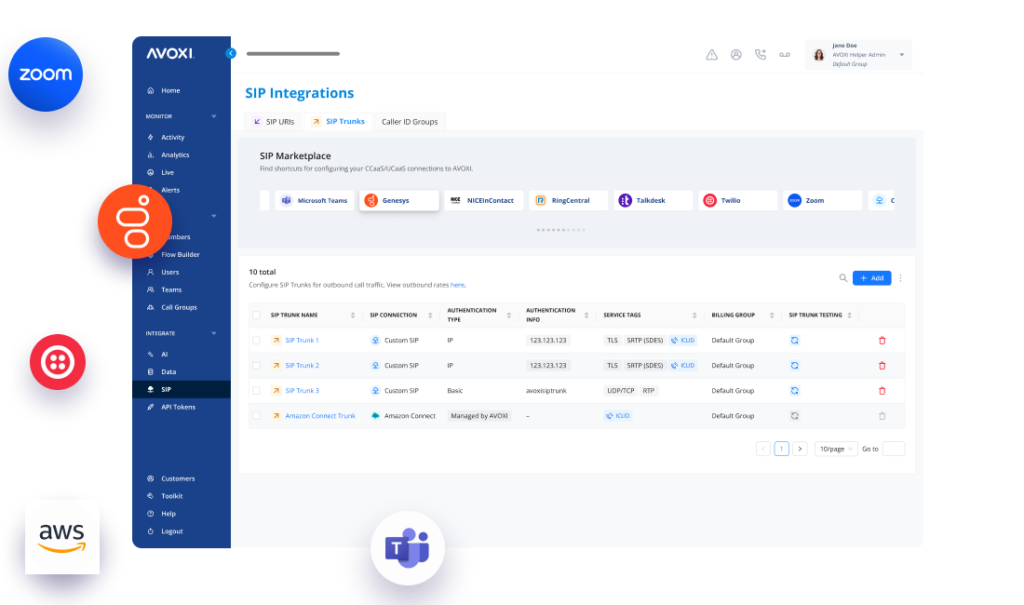
- SIP trunking moves trunks onto your IP network. Voice channels become software-defined, so you scale capacity in single-channel increments instead of full circuits. You also gain tighter integration with cloud platforms, global routing options, and centralized management across locations.
For enterprises, SIP trunking is increasingly the strategic default. AVOXI's cloud-native SIP trunking provides coverage in 150+ countries, with redundancy, quality monitoring, and integrations designed for leading CCaaS and UCaaS platforms—without additional carrier hardware at each site.
Analog vs. PRI vs. SIP Trunks: How Capacity, Hardware, Reliability, and Scalability Compare
When looking at the different types of trunks, they can vary in benefits and drawbacks. Here’s a closer look at a few key areas:
| Capabilities | Analog | PRI | SIP trunks |
|---|---|---|---|
| Capacity and efficiency | Allows one channel per phone line | Accommodates 23 or 30 channels per circuit—but only in blocks | Provisions exactly the number of channels you need |
| Hardware footprint | Depends on on-site gear | Depends on on-site gear | Needs minimal hardware |
| Reliability and resilience | Maintains predictable quality with limited failover over single physical path | Maintains predictable quality with limited failover over single physical path | Achieves resilience with carrier diversity, geographic redundancy, and intelligent routing |
| Scalability and global reach | Requires additional local carrier contracts, site visits, and long lead times with expansion | Requires additional local carrier contracts, site visits, and long lead times with expansion | Adds phone numbers and capacity across many countries within a single platform |
How Many Trunk Lines (Channels) Do You Need for Your Phone System?
Right-sizing trunk lines means matching concurrent call needs—not headcount—while leaving room for growth and protection against outages. Too few communication channels cause blocked calls, but too many wastes budget on capacity that rarely gets used.
To size correctly, consider a few different factors:
- Peak concurrent calls: Look at the highest number of simultaneous calls you see during busy periods. For reference, a 100-user office where 25 people are typically on calls at once needs about 25 channels as a baseline
- Busy-hour traffic: In your CDRs or analytics, identify the hour with the highest call volume and chart concurrent calls during that window. That data gives you a realistic picture of how many trunk channels your busiest periods actually require.
- Seasonal peaks and campaigns: Retailers, tax and legal firms, and B2B SaaS providers often see predictable spikes tied to holidays, fiscal cycles, or product launches. Size for those peaks, not just average days.
- Redundancy: If uptime targets are strict, distribute channels across regions or carriers so a single failure doesn't take your voice offline.
- Failover capacity: Decide how much traffic must survive a carrier or site outage—commonly 50%–100% of normal load for customer-facing teams.
- Use-case mix: Outbound-heavy operations (sales, collections) typically require more channels per user than inbound-only environments.
Be sure to layer in growth expectations over the next 12–18 months. If you anticipate a 25% increase in call volume, that 48-channel requirement moves closer to 60.
With SIP trunking, you can implement this model and adjust quickly as real-world usage comes in, instead of waiting on additional PRI circuits or analog lines.
How Do You Implement SIP Trunking with On-Prem, Cloud, or Hybrid PBX Platforms?
Migrating to SIP trunking is as much a network and security project as it is a telecommunications project. Success depends on preparing your IP network, protecting voice traffic, and executing a careful cutover—especially when production call flows are on the line. However, different setups have different needs:
- On-prem PBX environments usually need SIP-aware edge devices, QoS tuning, and firewall work.
- Cloud PBX and CCaaS platforms shift more of that complexity to your providers but still rely on stable, well-provisioned connectivity.
- Hybrid deployments add another layer, routing between legacy trunks, SIP trunks, and multiple platforms.
AVOXI's SIP implementations follow a structured approach: network assessment, security and redundancy design, then phased cutover and optimization.
1. Prepare the Network: Bandwidth, QoS, and Firewall/NAT Considerations
To kick off SIP implementation, start with these:
- Bandwidth planning begins with budgeting around 100 kbps per concurrent call (including overhead). A 50-channel SIP trunk requires roughly 5 Mbps reserved for voice, plus a safety margin for bursts and non-voice traffic.
- Quality of Service (QoS) policies ensure voice wins during contention. Classify voice traffic, assign it a high-priority queue, and enforce rate guarantees so large file transfers or backups don't starve calls of bandwidth—especially critical on WAN and internet uplinks.
- Firewalls and NAT must be SIP-aware. Open the appropriate signaling and RTP ranges your provider specifies, configure NAT so SIP headers reflect correct public IPs, and disable SIP ALG if it interferes with signaling. Many enterprises put a session border controller at the edge to centralize these controls.
Monitor end-to-end performance on the paths your voice will use. Aim for one-way delay in the low hundreds of milliseconds or better, minimal jitter, and near-zero packet loss.
2. Secure and Stabilize Voice: SBCs, Encryption, Redundancy, and E911 Readiness
Once you’ve prepped your network, work on security and stabilization:
- Session Border Controllers (SBCs) sit at the edge of your voice network, protecting against attacks and handling protocol translation. They help prevent toll fraud, block malformed SIP traffic, normalize signaling between systems, and control which endpoints can place and receive calls.
- Encryption protects signaling and media. TLS for SIP signaling and SRTP for voice streams safeguards customer conversations and reduces compliance risk, especially in contact centers processing payments or sensitive data.
- Redundancy design is where SIP trunk lines often outperform legacy circuits. Distribute trunks across providers and regions, configure automatic failover on your SBCs or PBX, and design routing so calls shift away from affected paths without manual intervention.
- E911 and emergency calling must also be addressed. Ensure each location has accurate address and caller information associated with its emergency endpoints, and validate routing to the correct public safety answering points—critical for multi-site and remote work environments.
Note that AVOXI's SIP platform includes enterprise-grade security features, carrier diversity, and E911 support, reducing the custom engineering you have to maintain on your own.
3. Complete the Cutover: Number Porting, Interop Testing, and Monitoring
With security and stabilization in place, the next step is rolling out a phased cutover:
- Number porting is often the longest-lead activity. Gather accurate records from existing carriers, submit port orders early, and schedule port windows during low-traffic periods. For multi-country environments, coordinate country by country based on local regulations and carrier timelines.
- Interoperability testing validates call flows before you fully cut over. Test inbound and outbound calls, international routes, codecs, DTMF, call recording, and failover behavior—including call transfers between platforms or sites.
- Monitoring and analytics should be live before the first production call. Track call completion rates, quality metrics, error codes, and trunk utilization. Alert on thresholds like sudden spikes in failures or abnormal drops in available channels.
If you need to tune capacity and routing based on actual performance, AVOXI supports guided porting, pre-cutover testing, and live analytics.
Should You Keep Legacy Trunk Lines or Migrate to SIP Trunking?
To decide between legacy trunk lines or SIP trunking for your business connections, begin with a clear inventory: which sites still rely on PRI or analog, what each circuit costs, and how heavily it's used. Many enterprises discover they're paying for circuits that sit idle outside narrow peak windows or maintaining PRI hardware at locations that are otherwise cloud-first.
SIP trunking tends to win when you're trying to:
- Consolidate vendors: Replace a patchwork of regional carriers with a single global voice provider to consolidate providers.
- Optimize spend: Remove per-circuit fees and hardware maintenance while aligning capacity with real usage.
- Modernize CX stack: Integrate directly into CCaaS, UCaaS, and analytics platforms instead of backhauling through legacy gear.
- Support global growth: Bring up numbers and capacity in new countries without on-site infrastructure.
In some cases you may keep a small number of PRI or analog lines for specific needs—elevator phones, alarm lines, or local survivability—while shifting the majority of traffic to SIP. A phased migration, running legacy and SIP trunk lines in parallel, lets you validate routing and quality before fully retiring older circuits.
AVOXI works with enterprises to plan these transitions in stages, aligning cutovers with business calendars and risk tolerance. If you're rethinking your trunk line strategy, a focused assessment and migration roadmap can help you move to SIP on your terms rather than on a carrier's end-of-life schedule.
If you're ready to rationalize legacy circuits, size SIP trunking correctly, or expand global voice coverage, reach out to AVOXI for a working session focused on your specific trunk line footprint and migration plan.
FAQs about Trunk Lines