
VoIP PSTN Interconnection: Options, Design, Security
VoIP has become the default for UC and contact centers, but you still live in a world that runs on phone numbers, emergency services, and local PSTN system regulations. You can move applications to the cloud, yet you can't avoid VoIP PSTN interconnection if you want reliable, compliant calling across markets.
This guide walks through how VoIP and PSTN work together, your main interconnect options, and the design, security, and migration decisions that matter most for an enterprise voice architecture and functionality.
Ready to streamline and strengthen your VoIP PSTN interconnection?
AVOXI puts everything you need in one place while trimming redundancy, bulking security, and establishing routing policies.
What Is PSTN vs. VoIP, and Why Does VoIP–PSTN Interconnection Matter for Modern Calling?
PSTN (Public Switched Telephone Network) is circuit-switched, meaning every call gets a dedicated path across carrier switches and physical telephone lines for the life of the call. Because of this, it delivers consistent behavior, but with a fixed infrastructure, it’s slow and expensive to extend globally.
VoIP (Voice over Internet Protocol), however, is packet-switched, so your voice is encoded into data packets and sent over IP networks using protocols, like Session Initiation Protocol (SIP) for signaling and Real-Time Transport Protocol (RTP) for media. This gives you software control, flexible routing, and far better cost-effective scalability, but it pushes reliability and quality questions onto your IP networks and VoIP service providers.
Unfortunately, you rarely get to pick one or the other, as you need both sides to cooperate for:
- Emergency services access: Most emergency frameworks (E911, E112, and local equivalents) still rely on PSTN routing and location databases.
- Regulatory compliance: Many countries tie local numbers, caller ID rules, and lawful intercept obligations to licensed PSTN carriers.
- Universal reach: Large portions of your customers, partners, and suppliers still sit behind traditional phone lines and mobile networks.
- Hybrid infrastructure: During migrations, you'll run a mix of cloud UC, CCaaS, and on-prem PBXs that all need PSTN termination.
How VoIP-to-PSTN Call Flow Works
The VoIP-to-PSTN call flow is broken into three areas: signaling, media, and conversion types, which we look at below..
Signaling
On the VoIP side, SIP messages (INVITE, 180 Ringing, BYE, and so on) handle call setup and modifications. But when the destination is a PSTN number, a gateway or SBC translates SIP into PSTN signaling such as SS7/ISUP, and for inbound calls from PSTN lines, the process reverses.
In this case, the carrier receives the dialed number, triggers SS7 signaling, and your interconnect point converts it into SIP destined for your PBX, UCaaS, or CCaaS platform.
Media
After signaling completes, RTP streams transport voice between IP addresses using codecs like G.711 or G.729. With PSTN, audio is carried as a continuous 64 kbps PCM stream across circuits. The interconnect device de-packetizes RTP, converts codecs as needed, and pushes audio into TDM channels—then reverses that for the other direction.
That translation has to happen in real time with very low latency, which is why underpowered or poorly placed gateways quickly show up as an echo, a clipping, or one-way audio.
Conversion
Conversion from VoIP to PSTN, or the reverse, can happen in a few places:
- Carrier SIP trunking: The carrier's network edge does the VoIP PSTN conversion for you.
- On-prem gateways: Conversion happens in your digital data center or comms rooms.
- Cloud voice platforms: Platforms like AVOXI convert within the provider's global network, presenting as SIP interfaces and APIs.
What Are the Main VoIP–PSTN Interconnect Options (and When Should You Use Each)?
You have three primary ways to connect Voice over IP workloads to the PSTN:
- Carrier SIP trunks: Usually the backbone of modern enterprise voice
- On-prem or SBC-backed gateways: Often used where you still run legacy PBXs or must keep traffic on premises
- Cloud voice or CPaaS interconnects: Best when you want global PSTN reach and elastic capacity without deploying hardware or managing multiple regional carriers
SIP Trunking to a Carrier (Origination/Termination and Direct Routing)
SIP trunking gives you a direct IP connection from your VoIP environment to a carrier that handles PSTN access. Your PBX, SBC, Teams tenant, or contact center platform sends SIP signaling and RTP media to the carrier's edge.
The carrier manages inbound (origination) from the PSTN to your numbers and outbound (termination) from your users to landlines and mobile phones. With Direct Routing models, you can also extend platforms like Microsoft Teams into regions where their native calling plans don't exist.
You'll usually choose SIP trunking when you:
- Need PSTN coverage across multiple countries without negotiating with local carriers one by one
- Are moving off TDM circuits and want to avoid new hardware spend
- Run UC or CCaaS platforms that need high-concurrency calling and predictable per-minute or per-channel pricing
- Want tight control over routing, numbering, and failover while offloading last-mile PSTN complexity
Look for geo-distributed SBCs, clear SLAs for availability and quality, fraud controls, and support for integrations like Microsoft Teams Direct Routing or RingCentral Global Office.
On-Prem or SBC-Backed PSTN Gateways (Analog, PRI, and Legacy Tie-Lines)
On-prem gateways and SBCs are best when you own significant TDM infrastructure or must keep voice traffic on your network for policy or regulatory reasons.
Typical scenarios include large Avaya, Cisco, or Mitel deployments not ready for full cloud migration, facilities where life-safety systems depend on analog lines, and regions where regulators require local PSTN breakout on customer premises.
Some of the most common gateway models are:
- Analog gateways (FXO/FXS) for small numbers of lines and devices
- PRI gateways to connect T1/E1 circuits into SIP environments
- Enterprise SBCs that combine security, interoperability, and media handling for multiple SIP trunks and PBXs
This approach gives you physical control with dedicated lines but also responsibility for hardware lifecycle, patching, capacity upgrades, and interop testing. Many teams now pair a small on-prem footprint with cloud SIP trunks from phone service providers like AVOXI to minimize hardware while still meeting local obligations.
Cloud Voice and CPaaS Interconnect (Hosted SIP, Global Reach, Elastic Capacity)
Cloud voice and CPaaS interconnects push PSTN complexity entirely into a provider's network. You bring your applications (e.g., UC, CCaaS, or custom platforms) and connect via SIP or APIs. You can spin up local DIDs, toll-free numbers, and outbound caller ID in new markets in hours, then scale channels up or down based on real demand instead of fixed-capacity circuits.
With AVOXI, you can provision numbers across 170+ countries from a single interface and use SIP trunks into Teams, Zoom Phone, or your PBX while the platform manages PSTN interconnects behind the scenes.
Plus, you can take advantage of built-in redundancy, fraud controls, and analytics without operating your own SBC fleet. This is usually the best fit for cloud-first architectures and global contact centers that prefer software and automation over telecom hardware and carrier contracts.
How Do You Design a Reliable VoIP PSTN Architecture for Quality and Resilience?
When designing a VoIP PSTN framework, you’ll need to verify what your VoIP phone system and PSTN network can handle and how well they’re handling it, among other areas.
How to Plan Capacity and Redundancy
For capacity planning, start with concurrent call modeling. Use historical data from your PBX or carrier CDRs to identify busy-hour call attempts and concurrent sessions, then add a safety margin–often around 20%–30% above your highest peaks—and adjust for seasonality, campaigns, or new lines of business.
Once you have a capacity plan in place, look into needed system redundancy, which can be accommodated in a few ways:
- Carrier diversity: Use more than one SIP trunk provider for critical workloads so a single provider issue doesn't silence key sites or queues.
- Path diversity: Terminate trunks in different data centers or regions, with automated failover driven by health checks and quality thresholds.
- Routing policies: Configure failover rules that reroute VoIP phone calls when latency, jitter, or packet loss exceed defined limits—not just when trunks are completely down.
Global VoIP providers such as AVOXI give you geo-distributed points of presence and built-in routing logic, so you can spread loads across regions and fall back automatically if a point of presence (PoP) or carrier partner has problems.
How to Manage Codecs and Media Quality
Make sure you have strong codec and quality management in place with these measures:
- Codec strategy: Use a small set of codecs across your environment. G.711 is typically best for PSTN legs because it avoids extra transcoding steps, and use compressed codecs like G.729 only where bandwidth is constrained. However, keep codec changes away from the VoIP PSTN boundary to limit processing delays.
- QoS and bandwidth controls: Prioritize voice on your WAN and LAN using DSCP markings and QoS policies. Reserve enough bandwidth per concurrent call based on your chosen codec and header overhead, then enforce those allocations on routers and switches so data bursts don't starve voice traffic.
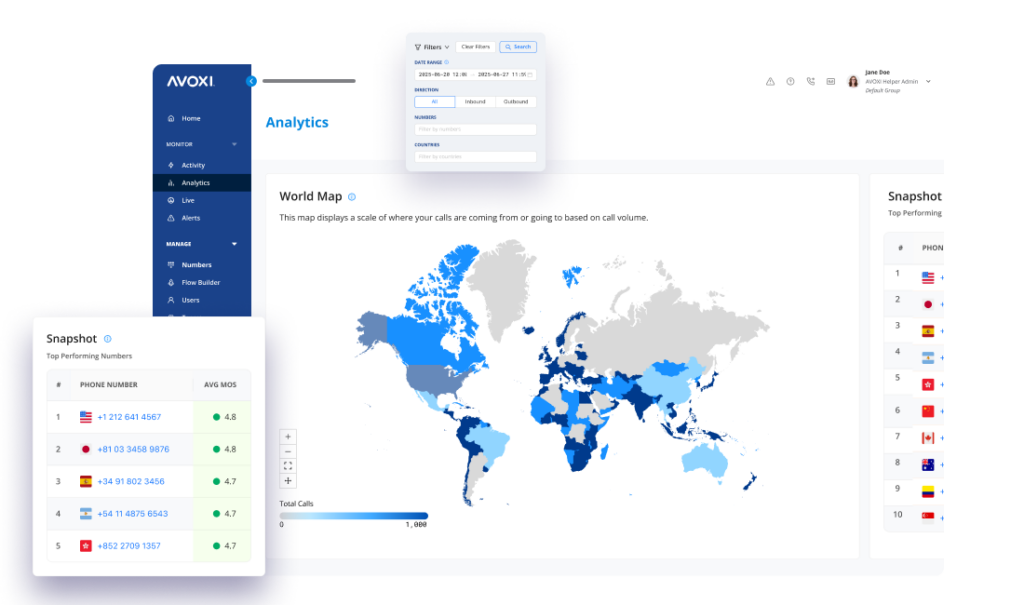
- Jitter and loss management: Configure jitter buffers on endpoints and SBCs to smooth packet arrival without adding unnecessary delay, then continuously monitor jitter, packet loss, and one-way latency with set alerts for thresholds that correlate with user complaints. AVOXI's call quality analytics expose these metrics by trunk, number, and region, helping you pinpoint whether issues come from your LAN, the public Wi-FI, or a specific PSTN interconnect.
What Security and Compliance Requirements Apply Across VoIP–PSTN Boundaries?
It’s imperative to keep your systems and processes secure and compliant, so be sure to fold essential controls and guidelines into your regular policies:
- Signaling and media security: Use TLS for SIP signaling and SRTP for media wherever possible. At the PSTN boundary, you'll terminate encryption and hand traffic to carriers over trusted interconnects, and your SBCs and providers should harden these points to prevent protocol abuse, malformed SIP, and other signaling attacks.
- Fraud and abuse controls: Toll fraud, international revenue share fraud, and abusive robocalls still exploit gaps between VoIP systems and PSTN carriers. Mitigation steps include real-time traffic analytics and anomaly detection, per-trunk and per-user limits on destinations and call attempts, and geo-blocking for destinations you never legitimately call.
- Regulatory compliance: Your architecture must reflect local rules for emergency services (E911/E112), caller ID presentation, number usage, data retention, and interception capabilities. In some countries, you may be expected to make emergency calls locally rather than centralizing them in another region, and working with a provider that already operates in your target countries reduces the risk of missing a local requirement.
How to Protect Identity and Reduce Fraud
To expand on telephony security, take steps to actively protect against fraud attacks and preserve sensitive information:
- STIR/SHAKEN and caller authentication: In IP-based networks such as those used in North America, STIR/SHAKEN frameworks let carriers cryptographically sign voice calls to attest that the calling number hasn't been spoofed. Work with SIP trunk providers that support signing and can deliver strong attestation levels for your enterprise numbers.
- Number reputation and presentation: Register your main outbound numbers with carriers and analytics ecosystems, use localized caller IDs where allowed, and avoid overusing the same numbers for high-volume outreach that might trigger spam labeling.
- Analytics-driven fraud detection: Use analytics to watch for unusual behavior, like new destinations, sudden volume spikes, or odd time-of-day patterns. Providers that expose this voice data in real time make it much easier to lock down a trunk or user before costs and brand impact escalate.
How Do You Choose and Implement the Right VoIP–PSTN Approach without Disruption?
To put a reliable VoIP–PSTN phone system in place, begin with a structured assessment:
- Current platforms: Catalog PBXs, UC, CCaaS, and custom apps that originate or receive calls.
- Geography: Map where users sit and where you need local numbers or emergency services coverage.
- Traffic profile: Understand call directions, destinations, and peak concurrency.
- Regulatory posture: Identify markets with strict emergency, recording, or data residency rules.
Then once your assessment is complete, take steps to reduce migration risk:
- Run VoIP and legacy PSTN in parallel during testing and early rollout.
- Cut over by site, department, or region instead of moving everything at once.
- Define measurable success criteria for quality and availability before you start.
- Plan number porting timelines and temporary call forwarding to avoid missed calls.
With AVOXI, you can standardize with cloud-based SIP trunking, then keep only essential on-prem gateways where mandated for centralized telecommunications management and supported global expansion—all while integrating with existing PBXs and connectivity platforms.
If you want to see how AVOXI can make the most of VoIP–PSTN interconnection, book a demo today.
FAQs about VoIP PSTN Interconnection