


AI-driven anomaly detection catches voice issues before customers do and cuts resolution time in half.
The Reality of Number Outages: Every Minute of Voice Downtime Compounds
A number goes down. Somewhere, a customer is dialing in for support, a partner is trying to close a deal, or a patient is trying to reach a care team…and the call never connects.
Nobody on the inside knows it yet.
That's the uncomfortable reality of traditional reactive voice monitoring. Most enterprises don't learn a number has failed because a system flagged it. They find out because a customer complained, an agent noticed a drop in call volume, or a regional office called in confused about why the phones went quiet. By the time IT or telecom teams start investigating, the issue has already been live for minutes, sometimes hours. And every one of those minutes has a cost: abandoned calls, frustrated customers, and agents left explaining an outage they didn't cause.
The issue isn't just "how fast can we fix it?" but also "how long does it take to even know something's wrong?"
Why Resolution Time Balloons Under Reactive Monitoring
Traditional number monitoring is built around a slow, multi-step relay:
- An issue occurs. A number stops connecting, or call quality degrades on a specific route.
- Someone notices…eventually. Without dedicated monitoring, detection depends on a customer complaint, an agent report, or a manual test call that happens to catch it.
- Manual investigation begins. IT teams try to reproduce the issue, coordinate test calls across regions, or wait on a third-party testing provider to confirm what's happening.
- The carrier gets looped in. Now there's a back-and-forth to identify which leg of the call path is failing and who owns the fix.
- A ticket finally gets filed, often with incomplete information. Because the diagnostic data wasn't captured at the moment of failure, teams often have to reconstruct what happened after the fact.
Every handoff in that chain adds delay. And because most of it depends on a human noticing a problem first, the clock doesn't start ticking on resolution until the damage is already done. For enterprises operating across dozens of countries and carriers, that lag multiplies with scale. More numbers across more regions equal more chances for an issue to go unnoticed until it's customer-facing.
Introducing AVOXI Proactive Service: Compressing the Detection-to-Resolution Cycle
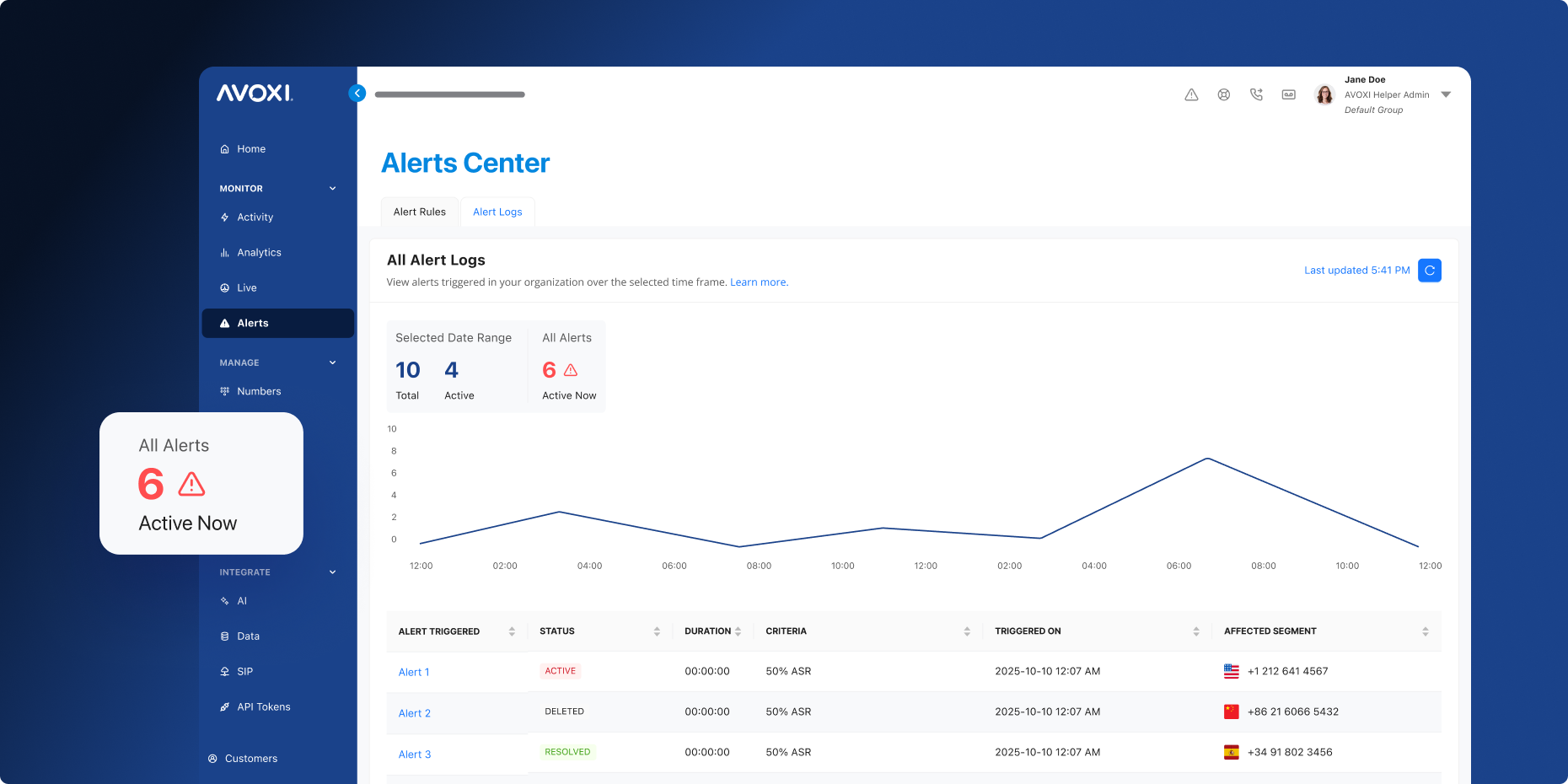
AVOXI Proactive Service was purpose-built to collapse that cycle. Built directly into the AVOXI platform, it uses AI and analytics to catch voice issues before they reach customers and automates the coordination steps that used to require manual work.
Here's how it changes the model:


The result is a detection-to-resolution model that starts working, often before a customer ever picks up the phone to complain.
Breaking Down the Numbers
AVOXI has measured this approach across millions of calls, and the results describe a meaningfully different resolution model:

Issues are identified before the client notices 97% of the time.
Because detection happens automatically at the number level, most problems are already flagged, and already being investigated, before an internal team or customer would have caught them.

Resolution is 2x faster than traditional industry approaches.
Removing the manual detection and triage steps means the resolution clock starts earlier and moves faster once it does.
It's worth being precise about what that 2x figure actually reflects: it's not that AVOXI's support team works twice as fast once a ticket lands. It's that the entire front half of the incident lifecycle, the part that used to depend on someone noticing and manually confirming an issue, is compressed into an automated, near-instant process. Faster detection means faster validation, which means faster engagement with the right people, which means a shorter window where customers are actually affected.
For IT and telecom professionals, that's the part of the math that matters most: the biggest source of delay in a traditional model isn't the fix itself, it's everything that has to happen before the fix can even start.
What This Means for IT and Telecom Teams
Faster resolution isn't just a nice metric; it changes how teams operate day to day.

Fewer emergency escalations.
When issues are caught and validated automatically, fewer incidents reach the point of a customer-reported outage or an executive escalation.

Less manual triage.
IT and telecom staff spend less time confirming whether an issue is real, coordinating test calls across regions, or chasing down carrier confirmation because that legwork is already done by the time a case reaches them.

Resources redirected to higher-value work
Time that used to go toward manual monitoring and reactive troubleshooting can go toward strategic projects instead.

Stronger, more consistent customer experience.
Fewer prolonged outages mean fewer disrupted customer interactions, which protects both revenue and brand trust, particularly for highly regulated industries or high-volume contact center environments where every missed call carries a real cost.
This is also where AVOXI's broader platform advantage comes into play. Proactive Service isn't a bolt-on tool sitting outside your voice environment. It's built into the same one-stop AVOXI platform that provisions, routes, and analyzes your global voice traffic. What's more, number-level anomaly detection is only as good as the coverage behind it. AVOXI's number testing capability, which underpins Proactive Service's validation step, spans over 120 countries, giving enterprises a level of in-country testing depth that most third-party or carrier-side monitoring simply can't match. When an anomaly is detected on a number in a specific market, the AVOXI platform can validate it from within that market, not from a simulated or generic vantage point.
The AVOXI Difference
Proactive by design, not reactive by necessity. Proactive Service doesn't wait for a complaint or a scheduled test cycle. It continuously analyzes traffic against a number's own historical baseline, so anomalies are caught as they emerge.
Automation replaces manual coordination, not just manual labor. From anomaly detection to test validation to case creation, the entire front half of the incident lifecycle happens without IT having to initiate it—cutting down the handoffs that slow resolution down.
Built into a global voice platform, not bolted onto one. Because Proactive Service runs on the same platform that handles the entire voice portfolio, detection and resolution benefit from the same in-country testing depth and carrier relationships that power the rest of AVOXI's voice services.
The Bottom Line
For global enterprises, voice downtime is more than an IT problem. It can tank revenue and brand trust. The traditional model for handling it has always been slower than the business needs it to be.
AVOXI Proactive Service changes the math by moving detection and validation ahead of the curve:
- Issues identified before the client notices 97% of the time
- Resolution up to 2x faster than traditional approaches
- Automatic case creation that removes manual triage from the equation
- Powered through AVOXI's cloud voice platform and designed for global voice management at scale
Ready to Learn More About Proactive Service?
See how Proactive Service catches voice issues before your customers do and cuts resolution time in half.

You Might Also Be Interested in

Need Help Getting US Phone Numbers?
We're here to help! Contact us today so we can help find the right business phone number for you.