

AI is changing how contact centers handle voice, but most enterprises hit a wall before their first virtual agent takes a live call.
The problem is rarely the AI model itself, but the telephony layer underneath it — the network, SIP connections, and audio processing pipeline that were never designed to support real-time AI workloads.
The result is predictable: Virtual agents that sound robotic because of latency spikes, speech-to-text engines that miss words because of codec mismatches, and fragmented carrier setups across countries that make consistent AI deployment impossible. When the voice infrastructure cannot keep up, even the best AI model underperforms.
This guide breaks down:
- What voice AI infrastructure means and how it differs from standard cloud telephony
- The core components of a production-ready voice AI stack
- Why legacy voice systems fail under AI workloads
- How to evaluate whether your voice infrastructure is AI-ready
- Where AVOXI fits in the voice AI infrastructure stack
Struggling to pinpoint why your AI voice agents underperform across regions?
With AVOXI, you get the carrier-grade global voice layer purpose-built for AI workloads, so your virtual agents sound natural and respond accurately in 150+ countries.
What Voice AI Infrastructure Means
Defining the Telephony Layer
Voice AI infrastructure is the carrier-grade telephony layer — network, SIP, audio processing, and routing — purpose-built to support AI-driven voice applications at scale. It sits between your AI application and the PSTN, and it determines whether a virtual agent sounds human or drops calls mid-sentence.
This is not consumer-grade voice technology. Voice assistants on phones and smart speakers operate in low-concurrency, best-effort environments. Enterprise voice AI infrastructure handles thousands of concurrent sessions across global carrier networks with strict latency, uptime, and audio fidelity requirements.
How It Differs From Consumer Voice AI
The distinction matters for IT and telecom buyers evaluating vendors. Consumer voice AI runs on commodity internet connections and tolerates degradation gracefully — a missed word from a smart speaker is an inconvenience.
In a contact center, a missed word from a virtual agent costs a sale or escalates a support case. The infrastructure underneath the AI model is what separates those two outcomes.
Core Components of a Voice AI Infrastructure Stack
A production-ready voice AI stack has three layers: The carrier-grade network that delivers audio globally, the SIP and API integration layer that connects AI platforms to that network, and the real-time audio processing pipeline that keeps latency and fidelity within the thresholds AI applications require.
Carrier-Grade Global Voice Network
AI voice applications demand more from the network than traditional telephony. A single virtual agent session requires low-latency, high-fidelity audio delivery in both directions simultaneously, and hundreds or thousands of those sessions may run concurrently across multiple countries.
That requires Tier 1 carrier partnerships with direct interconnects, geographically distributed points of presence that minimize round-trip latency, and built-in redundancy so a single carrier outage does not take down AI operations in an entire region.
SIP and API Integration Layer
SIP trunking is the connective tissue between AI platforms and the voice network. It carries the signaling and media streams that AI applications depend on for real-time input and output.
For AI workloads, the SIP layer must support secure transport protocols, flexible codec negotiation, and high session density without degradation. A programmable voice API adds real-time call control on top of SIP, which enables AI applications to route, record, transfer, or modify calls programmatically during a session.
Real-Time Audio Processing and Routing
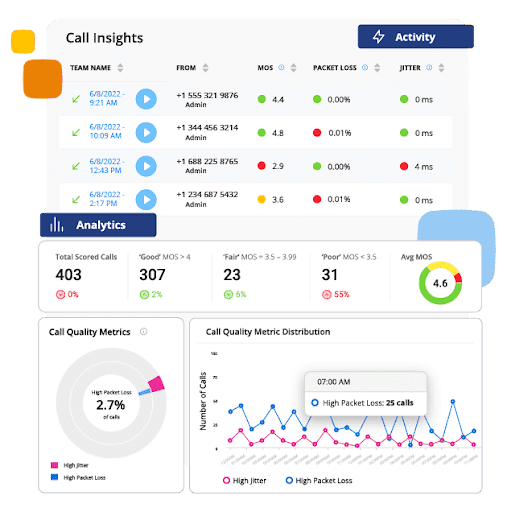
Audio quality directly affects AI agent performance. Speech-to-text accuracy drops measurably when the Mean Opinion Score falls below 4.0, and even small increases in jitter can cause an AI agent to miss conversational cues or respond to incomplete utterances.
The audio processing layer handles codec transcoding, jitter buffering, echo cancellation, and packet loss concealment — all in real time, with latency budgets measured in milliseconds.
Intelligent call routing ensures each session takes the lowest-latency path through the network, which is especially critical for AI applications that need sub-150-millisecond round-trip audio delivery to maintain natural conversational flow.
Why Legacy Voice Systems Fail Under AI Workloads
Three failure modes come up consistently when enterprises try to run AI workloads on voice infrastructure that was built for human-to-human calls: Latency that degrades speech recognition, codec mismatches that introduce artifacts at the transcoding boundary, and vendor sprawl that fragments quality and API access across regions.
Latency and Speech Recognition Degradation
Legacy PBX and on-premises voice systems were built for human-to-human calls, where participants naturally adapt to slight delays.
AI agents cannot adapt the same way. When round-trip latency exceeds 150 milliseconds, speech-to-text accuracy degrades, and conversational timing breaks down. The AI agent starts responding too early or too late, creating an experience that feels mechanical rather than conversational.
Codec and Transcoding Mismatches
Older PSTN interconnects and legacy PBX systems often use narrowband codecs like G.711 or G.729, which were designed for voice intelligibility — not the wideband fidelity that AI speech engines prefer.
When a call crosses from a legacy interconnect into a cloud AI platform, the transcoding process introduces audio artifacts that reduce speech recognition accuracy. Each additional transcoding hop compounds the problem.
Vendor Sprawl Across Geographies
Enterprises operating voice in 10 or more countries commonly manage relationships with six or more voice providers. This is a pattern that a 2024 Metrigy survey of 371 IT and voice decision-makers confirmed affects 59% of multinationals.
That sprawl creates inconsistent audio quality from country to country, no unified API surface for AI integration, and per-country troubleshooting that slows every deployment. When call quality was cited as the top international voice challenge by 59% of respondents in that same survey, the connection to multi-vendor complexity is difficult to ignore.
How to Evaluate Voice Infrastructure for AI Readiness
Use these three areas to benchmark any voice provider against the requirements your AI applications actually impose: raw performance (latency, MOS, codec support), integration depth (SIP interoperability and API access), and compliance posture across your coverage footprint.
Performance Benchmarks: Latency, MOS, and Codec Support
Start with the numbers your AI applications actually need. Round-trip latency should stay below 150 milliseconds for real-time conversational AI. MOS should be 4.0 or above as a floor, with 4.4 or higher as the target for production AI workloads.
The platform should support wideband codecs natively and handle transcoding without introducing artifacts that degrade speech engine accuracy.
Integration and API Accessibility
Evaluate whether the voice platform offers SIP interoperability with your CCaaS, UCaaS, and AI platforms, and not just on a compatibility list, but in production with documented reference architectures.
API accessibility matters too: you need programmatic control over call routing, recording, and real-time session management, not just provisioning endpoints. The AVOXI platform is one example of an architecture built around API-first voice control for exactly these integration patterns.
Compliance and Global Coverage
AI voice deployments compound the compliance surface area. You need a voice provider that handles GDPR, HIPAA, PCI-DSS, and regional telecom regulations across every country where your AI agents operate.
Coverage depth matters as much as coverage breadth: Having a number in a country means nothing if the underlying carrier interconnect cannot deliver the latency and MOS your AI requires in that market.
For enterprises handling voice across 10 or more countries, a single-platform approach simplifies evaluation significantly. Instead of auditing latency, codec support, and compliance posture for each regional provider, you audit one.
Where AVOXI Fits in the Voice AI Infrastructure Stack
AVOXI maps to the three infrastructure layers this guide covers: the carrier-grade global network, the SIP and API integration layer, and the low-latency routing that keeps AI applications performing across regions.
Carrier-Grade Global Foundation
AVOXI's AI-ready voice platform delivers the carrier-grade foundation that AI applications depend on: 80+ Tier 1 carrier partners, coverage across 150+ countries, a 4.49+ average MOS, and 99.995% uptime. For your AI stack, that translates to consistent audio fidelity and availability in every market where you deploy virtual agents.
SIP and API Integration
The SIP integration layer connects to leading CCaaS platforms like Genesys, Five9, and Amazon Connect, as well as UCaaS platforms including Microsoft Teams and Zoom. The programmable voice API enables real-time call control (routing, recording, and transfer), so your AI applications can manage sessions programmatically without vendor-specific workarounds.
Low-Latency Performance Across Regions
Nine globally distributed cloud points of presence and intelligent auto-routing ensure that media takes the most efficient path between callers and your AI applications. For enterprises running virtual agents across multiple regions, that architecture keeps round-trip latency within the thresholds that conversational AI requires to sound natural and respond accurately.
You bring the AI stack — the speech engines, the conversational models, the analytics layer — and AVOXI powers the voice layer underneath so all of it performs. To see how this approach compares to your current setup, read more about voice infrastructure readiness for AI.
Ready to evaluate whether your voice infrastructure can support your AI roadmap?
AVOXI's global voice engineering team can assess your current stack against the benchmarks in this guide and map a path to AI-ready infrastructure.
FAQs About What Is Voice AI Infrastructure
How does voice AI infrastructure differ from CPaaS?
CPaaS platforms provide communication APIs for building voice, messaging, and video into applications. Voice AI infrastructure is a narrower, deeper layer focused specifically on carrier-grade telephony performance -- latency, MOS, global carrier routing -- that AI voice applications require. A CPaaS may sit on top of voice AI infrastructure, but it does not replace the underlying network quality requirements.
What industries benefit most from voice AI infrastructure?
Any industry running high-volume voice operations across multiple countries benefits, but financial services, healthcare, travel and hospitality, and BPO/outsourced contact centers see the most immediate impact. These sectors handle sensitive, time-critical conversations where AI agent accuracy and audio quality directly affect customer outcomes and compliance obligations.
Can voice AI infrastructure integrate with existing contact center platforms?
Carrier-grade voice AI infrastructure connects to CCaaS and UCaaS platforms through SIP and API-based integrations. You do not need to replace your contact center software to upgrade the voice layer underneath it. The integration works alongside your existing stack -- Genesys, Five9, Amazon Connect, Microsoft Teams, and others -- without requiring a platform migration.
What role does SIP trunking play in voice AI infrastructure?
SIP trunking carries the signaling and media streams between your AI applications and the carrier voice network. It controls how calls are established, how audio is encoded and delivered, and how sessions are transferred between AI agents and human agents. The quality, security, and scalability of your SIP layer directly determine how well your AI voice applications perform in production.

2026 EDITION
The State of International Voice for the Contact Center
AI, Outbound and Security Reshape Global Voice Strategy


You Might Also Be Interested in
Your AI Stack Is Only as Good as Your Voice Layer: A Guide for IT Directors

Need Help Getting US Phone Numbers?
We're here to help! Contact us today so we can help find the right business phone number for you.