
RingCentral Competitors: Alternatives for Enterprises (2026)
Enterprises that manage global voice communications often face challenges that small businesses rarely encounter, including varying call quality by region, coverage gaps in remote markets, and slow operations due to coordinating multiple vendors. As a result, many global IT and telecom leaders turn to AI-enhanced voice systems, but results often fall short.
RingCentral is a reliable unified communications option, but it can’t meet the scale or compliance demands of multinational enterprises. Large enterprises require consistent global coverage, regulatory readiness, and simplified vendor management that RingCentral and many of its small-to-midsize business (SMB) market competitors often can’t deliver.
Recognizing these needs is the first step toward choosing a platform that truly supports worldwide operations.
Key takeaways
- RingCentral works well for domestic and mid-market users but often struggles with international number availability, billing transparency, and diagnostic visibility.
- Selecting the right alternative requires evaluating scalability, total cost of ownership, and global performance rather than focusing solely on upfront pricing.
- Leading alternatives, such as AVOXI and Cisco Webex Calling, offer broader coverage, stronger compliance support, and deeper analytics integration.
- AVOXI stands out for its reach over 150 countries, unified UCaaS and CCaaS integrations, and transparent global pricing that simplifies management.
Why do enterprises switch from RingCentral?
As organizations expand into new regions, the limits of RingCentral’s single Unified Communications as a Service (UCaaS) platform become easier to see. While it performs reliably for domestic teams, global operations demand far more flexibility. The lack of global agility often creates operational pain points, such as delays in number provisioning, inconsistent caller identity abroad, and complex billing that can delay or interrupt service access and overload IT workloads. These issues compound as businesses scale, often resulting in higher costs and reduced visibility across markets.
The following areas highlight where enterprises typically encounter challenges when relying on RingCentral for international communication:
International voice limitations
Enterprises that operate in dozens of countries need consistent, compliant voice connectivity everywhere. That’s where the gap between RingCentral’s capabilities and enterprise demand becomes apparent. Here are some of its limitations:
- Coverage gaps: In hard-to-reach regions, like parts of Africa, Southeast Asia, or South America, RingCentral’s limited local number availability often forces companies to rely on secondary providers to fill the gaps.
- Caller ID inconsistencies: Outbound calls from global offices may appear as “unknown” or display incorrect caller IDs, which can reduce answer rates and damage customer trust. Some users also report inconsistent voice quality between regions. One G2 reviewer said, “I find the quality of the calls to be inconsistent. Sometimes the call quality is low or medium, which seems to depend on the internet connection and service provider.”
- Regulatory hurdles: Managing data residency and telecom compliance in multiple jurisdictions adds a layer of complexity that RingCentral’s centralized model doesn’t fully address.
Each of these issues impacts customer experience, agent productivity, and compliance posture. Across multiple regions, this operational friction results in reduced visibility into global performance.
Cost and billing complexity
Price transparency remains a significant challenge for global enterprises. RingCentral’s pricing structure appears straightforward at first, but variable international rates, surcharges, and feature add-ons can drive up costs. As usage grows across regions, monthly expenses often fluctuate, making it challenging to predict budgets or justify spending.
Beyond the rates themselves, managing consolidated billing across subsidiaries can be a cumbersome task. Finance teams may spend hours reconciling invoices and usage data instead of focusing on analysis and optimization. Over time, inconsistent reporting and regional billing variations can also erode cost visibility. This loss of financial clarity is often a breaking point for enterprises that are seeking more predictable and transparent global voice solutions.
Vendor sprawl and integrations
As organizations expand, their communication stack naturally grows, with many relying on specialized tools for analytics, contact center routing, or regional voice delivery. With RingCentral, the integration burden increases because the platform often depends on third-party carriers and integration partners to support global coverage.
While that reliance on partner-based integrations can be helpful for smaller deployments, it becomes a liability at the enterprise scale for the following reasons:
- Multiple vendors mean multiple support contacts, SLAs, and billing systems, causing unnecessary complexity.
- IT teams must coordinate across providers to resolve routing or quality issues.
- Integrations with Contact Center as a Service (CCaaS) or UCaaS platforms may require additional configuration or licensing.
Over time, this patchwork approach slows response times, strains troubleshooting workloads, and compromises the unified visibility enterprises need for reliable global operations. As one reviewer explained, “Sometimes the integration fails to call, so I have to uninstall and reinstall or open the web page to ensure I can call people quickly.”
The 9 best RingCentral alternatives in 2026
RingCentral remains a reliable UCaaS platform. But today’s global enterprises are seeking solutions that offer broader coverage, deeper compliance, and stronger diagnostic capabilities.
To help you evaluate your options for the best business phone system, the following table compares leading RingCentral alternatives based on the features enterprises value most: global number coverage, call monitoring, integrations, and scalability:
| AVOXI | Offers numbers in over 150 countries | Provides Call Insights dashboards and diagnostics | Integrates with UCaaS and CCaaS platforms like Genesys, NICE, Zoom, and Microsoft Teams | Offers managed porting and single-platform global voice, supports large enterprise operations |
| 8x8 | Provides international reach, but its capabilities are limited for complex global operations | Offers standard analytics and reporting | Has strong UCaaS and CCaaS features for mid-market businesses | Is strong for distributed teams but may require add-ons for full global scale |
| Nextiva | Focuses primarily on domestic and national scale rather than global voice | Has strong user-facing support and analytics for internal communications | Offers customer relationship management (CRM) platform integrations | Is best suited for SMBs and smaller enterprises rather than global fleets |
| Vonage | Supports global operations, but deeper global carrier reach varies | Provides reliable quality but fewer advanced diagnostics out-of-the-box | Offers developer-friendly APIs that support custom workflows | Is flexible for custom global setups but may require more internal resources |
| Cisco Webex Calling | Has an enterprise-grade infrastructure and global branch support via the Cisco network | Offers strong network monitoring and enterprise management | Features deep integration with Cisco’s collaboration suite and major platforms | Is highly scalable in enterprise environments, especially Cisco-centric ecosystems |
Here’s a deeper look at the capabilities and trade-offs of each of these RingCentral alternatives, plus four more enterprise voice solutions:
1. AVOXI
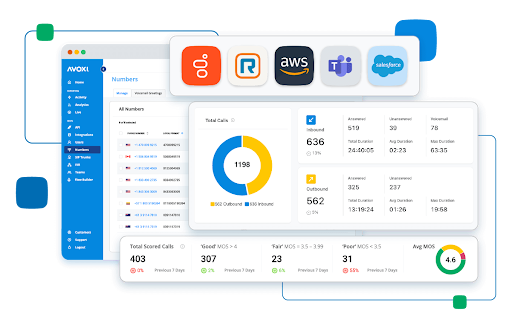
AVOXI delivers enterprise-grade cloud Voice over Internet Protocol (VoIP) services in over 150 countries, helping global organizations consolidate vendors, maintain compliance, and ensure consistent call quality. Its AI-ready voice platform integrates seamlessly with major UCaaS and CCaaS providers, offering visibility and control over global business communications. Additionally, the platform’s user-friendly interface and range of advanced call management features make it ideal for enterprises seeking reliability and flexibility at scale.
Key features:
- Global number coverage: Access and manage local and toll-free numbers in over 150 countries to expand your business presence instantly.
- Managed porting: Move existing numbers across more than 100 markets to minimize downtime and ensure service continuity.
- Call Insights diagnostics: Monitor key metrics such as latency, jitter, and packet loss to ensure consistent voice quality across all regions.
- TrueLocal™ routing: Display local caller IDs to increase answer rates and build customer trust.
- UCaaS and CCaaS integrations: Connect with platforms like Genesys, NICE, Zoom, and Microsoft Teams to centralize your operations and streamline your workflows.
- Compliance support: Meet regional telecom and data regulations through built-in safeguards and governance controls.
- Call recording, IVR, auto attendant, and call forwarding: Efficiently manage inbound and outbound workflows while maintaining security and compliance.
Pros:
- AVOXI provides unmatched coverage and regulatory support for multinational enterprises.
- It delivers real-time visibility into global voice performance and user experience.
- The platform simplifies operational complexity by consolidating multiple vendors into a single platform.
Cons:
- It requires initial setup for integrations and analytics.
- AVOXI isn’t a complete UCaaS replacement because it doesn’t provide team messaging and video conferencing on the same platform.
2. 8x8
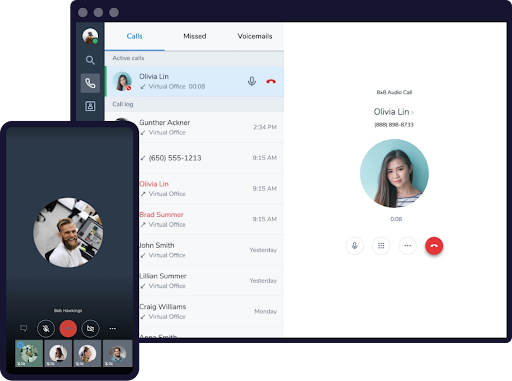
8x8 offers unified communications and contact center capabilities on one platform. It serves mid-size and enterprise organizations seeking reliability, analytics, and some global reach.
Key features:
- Integrated UCaas and CCaaS: Combine UCaaS and CCaaS with native integration for voice, video, chat, and contact center features in a single solution.
- Analytics and reporting: Use detailed dashboards to analyze call performance and user behavior.
- AI-powered intelligence: Deploy conversation intelligence, automated quality management, and real-time agent assistance across customer interactions.
Pros:
- This platform offers a solid all-in-one solution for distributed teams.
- 8x8 provides good analytics and reporting functionality.
Cons:
- Its global number coverage is limited compared to enterprise-grade alternatives.
- Expanding internationally often requires using third-party carriers or add-ons.
3. Nextiva
Nextiva focuses on simple, all-in-one communications for SMBs and small enterprises. While it’s well-known for its user-friendly setup and responsive support, it doesn’t support multinational operations.

Key features:
- All-in-one communication hub: Combine calling, messaging, and CRM features into one easy-to-use platform.
- Automation tools: Automate call routing and follow-ups to improve response times.
- Customer experience suite: Provide insights from customer interactions through integrated reporting.
Pros:
- This platform is easy for smaller organizations to deploy and maintain.
- Nextiva provides strong onboarding and customer support.
Cons:
- It lacks global coverage and compliance depth for enterprise deployments.
- The platform offers limited scalability for complex routing or multi-region setups.
4. Vonage
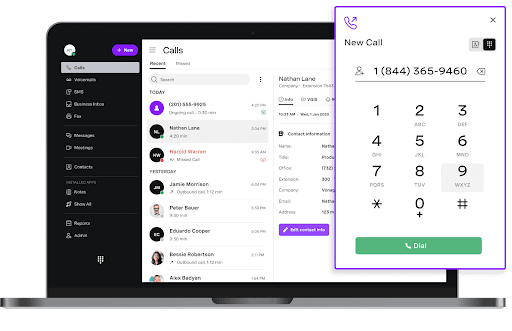
Vonage provides both UCaaS and Communications Platform as a Service (CPaaS) capabilities and enables flexibility through APIs, which suits enterprises that want to create customized communication workflows.
Key features:
- CPaaS platform: Develop custom communication experiences using programmable voice and messaging APIs.
- Unified communication tools: Manage calls, text messages, and meetings through a single interface.
- Contact center integrations: Connect easily with CRM platforms and support systems to centralize your operations.
Pros:
- Vonage enables high customization for technical teams and developers.
- It offers reliable uptime and scalable infrastructure.
Cons:
- Custom API setup requires development resources and longer implementation time.
- Its global number coverage relies heavily on regional carrier partnerships.
5. Cisco Webex Calling
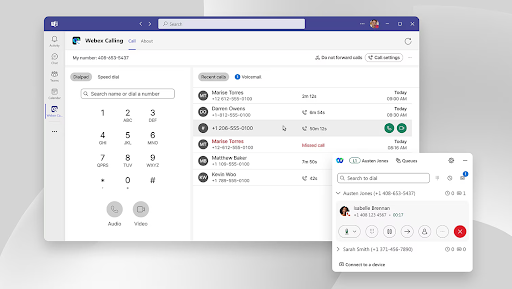
Cisco Webex Calling combines strong reliability with enterprise-grade security and integrates tightly within the Cisco ecosystem, making it a natural fit for organizations already using the Cisco infrastructure.
Key features:
- Secure cloud calling: Protect your voice data with end-to-end encryption and network controls.
- Collaboration suite integration: Connect seamlessly with Webex’s Meetings, Messaging, and Contact Center apps.
- Network visibility: Manage devices and monitor network performance to maintain call quality.
Pros:
- Webex Calling offers best-in-class security and reliability.
- It scales effectively within enterprise Cisco environments.
Cons:
- Setup and customization can take longer for new Cisco users.
- Integrating with systems outside Cisco’s ecosystem often requires additional configuration.
6. Zoom
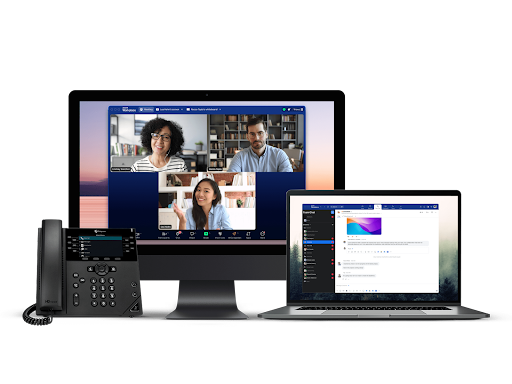
Zoom’s UCaaS product, Zoom Phone, extends its familiar video meeting experience into cloud calling. It’s ideal for hybrid or remote teams but focuses more on SMBs than large-scale enterprise voice.
Key features:
- Zoom Phone integration: Add voice calling within the Zoom app to simplify user adoption.
- Global reach: Support international calling in multiple countries through centralized administration.
- App integrations: Connect with CRM platforms and productivity apps to enhance your team’s communication.
Pros:
- Zoom Phone is straightforward to use for users already familiar with Zoom’s video ecosystem.
- It supports hybrid teams with intuitive mobile and desktop options.
Cons:
- Zoom offers limited diagnostics and monitoring tools for enterprise-grade oversight.
- Its compliance and routing features are also less advanced than those from specialized global providers.
7. Dialpad
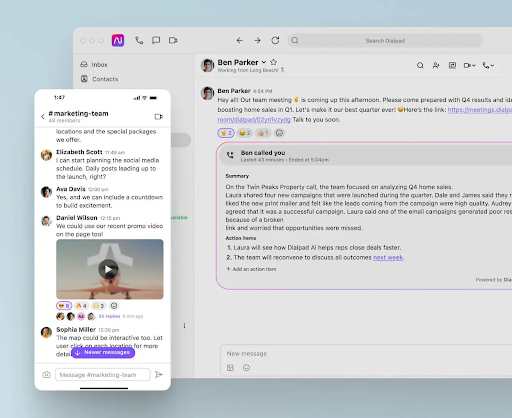
Dialpad leverages AI to enhance meetings, calls, and collaboration. The platform is primarily suited for SMBs and mid-size companies focused on productivity improvements.
Key features:
- AI call summaries: Automatically create transcripts and key takeaways after each call to save time.
- Multi-channel communication: Manage voice, SMS, and meetings from a unified dashboard.
- Native integrations: Sync seamlessly with Google Workspace, Microsoft 365, and Salesforce.
Pros:
- It offers impressive AI-driven features that improve daily efficiency.
- The platform is easy to deploy across small, distributed teams.
Cons:
- Dialpad offers a limited number of phone numbers for global operations.
- It lacks advanced call quality diagnostics for large enterprise networks.
8. GoTo Connect
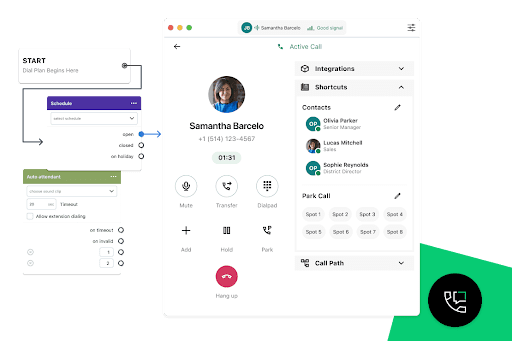
GoTo Connect is an SMB-focused, cloud-based comms platform that combines calling, messaging, and video in one solution. It prioritizes simplicity and fast setup, making it less suitable for deep enterprise scalability.
Key features:
- Unlimited domestic calling: Make unlimited calls in the US and Canada across all plans without minute restrictions or overage charges.
- Integrated collaboration tools: Access video conferencing and screen sharing capabilities on the same platform.
- Flexible device support: Deploy mobile and desktop apps for remote and hybrid work arrangements.
Pros:
- The platform is easy to use with minimal training.
- It works well for domestic or regional teams.
Cons:
- GoTo Connect is more for SMBs than large enterprises with complex requirements.
- Its international capabilities are limited compared to specialized global voice alternatives.
9. Ooma Office
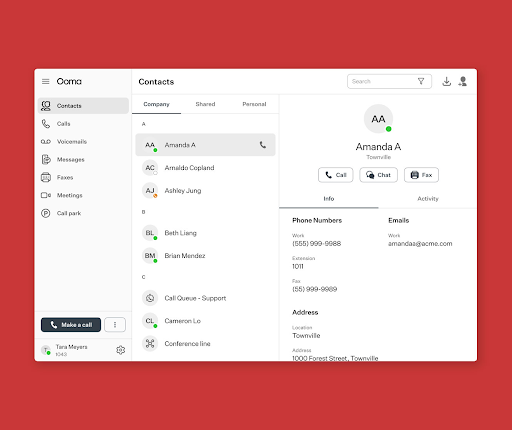
Ooma Office targets small businesses that need reliable, affordable VoIP without complex management. It also provides straightforward tools for teams that operate in local markets.
Key features:
- Virtual receptionist: Route inbound calls efficiently through automated menus.
- Mobile and desktop apps: Keep employees connected from anywhere with flexible device options.
- Voicemail transcription: Convert messages to text for quick access and follow-ups.
Pros:
- The platform is quick and easy to implement for smaller teams.
- It provides consistent call performance for domestic users.
Cons:
- Ooma Office works best for SMBs with fewer than 50 employees, making it less suitable for enterprises.
- It offers limited integrations with UCaaS or CCaaS ecosystems.
What to look for in a RingCentral alternative
The right RingCentral alternative must support your enterprise voice strategy—and you must base your selection on more than just price or features. The best solutions strengthen your coverage, compliance, and analytics, and reduce the number of vendors your team must manage.
Each of the following criteria plays a crucial role in determining whether a provider can meet enterprise-level demands:
Global number coverage
Reliable number availability is the foundation of global communication. Without it, expanding into new markets becomes costly and unpredictable. Strong coverage also ensures that your teams can reach customers anywhere while maintaining compliance and local presence.
When evaluating providers, pay attention to these capabilities:
- Reach and availability: Verify that the provider offers local and toll-free numbers across both established and emerging markets.
- Provisioning speed: Check how quickly you can activate numbers to prevent delayed rollouts.
- Regulatory compliance: Ensure that you meet local telecom and data residency requirements in all relevant regions.
For instance, AVOXI’s global reach across more than 150 countries allows enterprises to scale seamlessly while maintaining compliance and reliability in every target market.
Quality monitoring and support
Call quality issues don’t declare themselves through obvious failures. Instead, quality degrades gradually, caused by packet loss (moments of silence), jitter (robotic audio artifacts), or latency (awkward conversational gaps). By the time customers complain, you’ve already lost opportunities and damaged relationships.
To avoid these issues, your quality monitoring should include these essential features:
- Proactive diagnostic dashboards: Access real-time monitoring of your Mean Opinion Score (MOS), jitter, latency, and packet loss to surface degradation patterns before they become apparent to customers.
- Follow-the-sun support: Ensure 24/7 expert assistance in the timezone where problems actually occur, not just during your headquarters’ business hours.
- Root cause isolation: Use diagnostic data to determine whether issues originate from local internet connectivity, voice provider infrastructure, or destination carrier networks.
For example, if a Mexico City call center suddenly experiences quality issues, to fix the issue rapidly, you need data that shows precisely where the problem originates. Without this diagnostic capability, you’ll make uninformed changes as customer satisfaction declines.
Solve these challenges and more with AVOXI’s Call Insights platform to shift your organization from reactive firefighting to proactive quality management.
CCaaS and UCaaS integrations
Enterprises depend on multiple systems to operate contact centers, collaboration tools, and reporting workflows. Seamless integration between these platforms creates a unified communication environment, preventing data fragmentation.
AVOXI’s approach preserves your choice of CCaaS and UCaaS platforms while adding enterprise-grade global voice capabilities. Native integrations with Genesys, NICE CXone, Amazon Connect, Microsoft Teams, and Zoom Contact Center also mean you won’t have to choose between keeping your preferred contact center platform or gaining global voice coverage.
➜ Learn more about enterprise contact center solutions that enhance performance and visibility across global teams.
Total cost of ownership
For enterprises, the greatest challenge isn’t always the subscription—it’s the complexity behind the upfront price tag. Multiple contracts, inconsistent invoices, and unpredictable international rates can drive expenses higher than you expect.
To evaluate the total cost of ownership effectively, consider these factors:
- Vendor count: Regional provider consolidation reduces administrative overhead and billing errors.
- Operational efficiency: Platforms that automate management and reporting help reduce your manual workload.
- Billing transparency: Clear, consolidated invoices simplify reconciliation and improve budget control.
AVOXI simplifies ownership costs by offering global coverage with transparent pricing and centralized billing, all within a consolidated invoice. This helps finance and operations teams maintain accuracy and accountability across all markets.
Scalability
As enterprises grow, their communication needs evolve rapidly. They require a scalable solution that supports the expansion into new markets, accommodates additional agents, and adheres to evolving compliance requirements without forcing major system changes.
AVOXI enables immediate scalability through instant provisioning and managed porting. These capabilities enable enterprises to grow globally while maintaining compliance and delivering consistent service.
Choose a global-ready RingCentral alternative
For small and mid-sized businesses, price and convenience often guide the final decision on communication platforms. But at the enterprise level, priorities shift toward reliability, reach, and control.
Achieving this level of reliability, reach, and control carries a high failure rate if you end up managing multiple regional carriers or juggling disconnected systems. The wrong communications platform can drain your resources and limit your visibility into your global performance. The right global alternative should reduce those burdens and meet every call, connection, and compliance standard.
AVOXI meets the multiple needs and requirements of enterprises that operate without borders. Its global number coverage spans more than 150 countries. Its integrations with leading UCaaS and CCaaS platforms enable teams to stay connected through a single, secure, and compliant environment. AVOXI’s unified platform, combined with real-time call diagnostics, 24/7 support, and transparent billing, helps organizations optimize global performance and maintain cost predictability.
Is your enterprise ready to simplify its global voice operations and reduce vendor sprawl? Talk to a global-voice expert today to learn how AVOXI compares to RingCentral and how it can enhance your global voice communication.
FAQ about RingCentral competitors
Additional Resources to Help You Get the Needle Moving

PSTN Replacement
Guide to Voice Termination Services
Retain Phone Number
International
Number Porting

Virtual Phone Line
Benefits of
SIP Trunking

SMS Forwarding
Develop Brand
SMS Strategy