


Running global voice across a dozen local carriers means a dozen invoices, a dozen rate cards, and almost no leverage to negotiate any of them. SIP trunking pulls that spend onto a single connection, replacing PRI lines and long-distance charges with internet-routed calls you can price and forecast.
Cost control is why most telecom leads make the switch. This guide breaks down:
- How SIP trunk pricing works — per trunk, per channel, metered, and flat-rate
- How the models compare, and which fits your call profile
- A provider rate comparison and how to benchmark it
- The levers that actually lower your monthly bill
Ready to Cut Your Global SIP Costs?
Fragmented carrier spend is the most expensive way to run global voice, and the easiest to fix. AVOXI puts every market on one invoice, with elastic SIP trunking and Tier 1 voice quality across 150+ countries.
How SIP Trunk Pricing Works
SIP trunking pricing appears on a quote in several forms: per trunk, per channel, per minute, or as a flat monthly rate.
The components below break down each one you'll see, then a side-by-side comparison maps the three billing models to your call profile so you can pick the right fit.
Per-Trunk Pricing
In a per-trunk model, you pay a flat monthly fee for the trunk, and each trunk carries a set number of channels (often around 100). Estimate the concurrent calls your teams run at peak, since that concurrency determines how many trunks you actually need. Providers that include channels with the trunk simplify the math.
Per-Channel Pricing
A channel handles one call at a time, so per-channel pricing maps cost directly to concurrency. Many providers ship trunks with channels included and only charge for extra lines as volume grows. AVOXI takes the simplest approach: SIP trunks are $19.99 per month with unlimited channels, so concurrency never becomes a line item you have to manage.
Metered vs. Unmetered Plans
Most SIP plans bill one of two ways. Metered plans are pay-as-you-go: a per-minute rate that suits variable or seasonal traffic. Unmetered plans charge a flat rate for “unlimited” minutes, which usually means a high ceiling governed by a Fair Use Policy, not truly uncapped usage. Read the Fair Use terms before assuming a flat plan covers a high-volume contact center.
Virtual Phone Numbers
SIP trunking needs virtual phone numbers, and the type affects cost. The common ones are local DID/DDI numbers that route callers to a specific line, ITFS toll-free numbers that customers reach at no charge, and PSTN replacement numbers that show local caller ID on outbound calls. You can buy, port, or rent them. AVOXI virtual number packages start at $6.49 per month.
Setup and One-Time Costs
Some providers charge a one-time setup fee covering consultation, implementation, and Quality of Service (QoS) testing. Where it applies, confirm what the fee actually buys, since a guided implementation and QoS validation is a different value than a flat activation charge. AVOXI provisions SIP trunks online in minutes, with no separate setup fee on standard plans.
Per-Channel Pricing
A channel handles one call at a time, so per-channel pricing maps cost directly to concurrency. Many providers ship trunks with channels included and only charge for extra lines as volume grows. AVOXI takes the simplest approach: SIP trunks are $19.99 per month with unlimited channels, so concurrency never becomes a line item you have to manage.
Other Fees to Watch For
Beyond the headline rate, taxes and service charges show up on most invoices, along with a handful of usage-based add-ons. Ask any prospective provider how they handle the following so nothing surprises you at renewal:
- Bursting fee to temporarily open more channels during a call-volume spike
- Call forwarding fee to route calls to another number, device, extension, or voicemail
- Load balancing fee to distribute traffic across servers
- DNIS/ANI fee for surfacing the originally dialed number (DNIS) and identifying the caller's number (ANI)
Pricing Models Compared: Per-Channel vs. Metered vs. Unlimited
The fastest way to map a price to your business is to match the model to your call profile. The three dominant models trade off predictability against flexibility, and the right one depends on how steady your concurrency and volume are.
| Per-Channel | Flat fee per simultaneous call path | Steady, high-concurrency contact centers with predictable staffing | Paying for idle channels during off-peak hours |
| Metered (Pay-as-You-Go) | Per-minute rate on actual usage | Spiky, seasonal, or hard-to-forecast volume | Bills that swing month to month |
| Unlimited (Flat Rate) | Fixed monthly fee for a high-minute ceiling | High, stable outbound volume that wants one predictable number | Fair Use Policy caps and overage terms |
A 24/7 support center with consistent staffing usually lands on per-channel or unlimited pricing, because concurrency is predictable and a flat number is easier to budget.
A retailer with holiday spikes or a campaign-driven outbound team tends to do better on metered pricing, paying only for the minutes each surge consumes. Many enterprises mix models across regions, where a single platform pays off.
SIP Trunk Pricing Comparison by Provider
Negotiating a good rate is easier with benchmarks in hand, but SIP trunk providers constantly change their international per-minute rates due to carrier agreements and currency, so any snapshot ages quickly. The table below compares published US-route SIP pricing, sourced from each provider's rate page and pulled in June 2026.
US-Route Per-Minute Rate Comparison (June 2026)
| AVOXI | Published per-country rates; lowest rates on request | Included with number package | AVOXI outbound rates |
| Twilio | Published per-minute US rates; volume discounts available | Published per-minute local rate | Twilio SIP pricing |
| Vonage | Bundled into UCaaS plans (not published per minute) | Bundled | Vonage SIP pricing |
| Nextiva | Published via international rate lookup | Via rate lookup | Nextiva international rates |
Because providers publish rates in different formats and bundle SIP differently, line-by-line international tables are best read from the source. AVOXI publishes its average outbound SIP rates directly, and the lowest rates are available after a quick conversation with the SIP team.
How to Read and Benchmark International SIP Rates
Per-country rates move for reasons outside your control: carrier interconnect fees, currency shifts, regulatory surcharges, and route quality all feed the number. Because those inputs shift constantly, use a comparison to anchor a negotiation rather than lock in a figure, since the rate you see today may not hold by the time you sign.
With that in mind, pull each provider's rate for your highest-traffic destinations, weight them by your actual minute mix, and compare the blended cost; a cheap single-country teaser often hides a premium on the routes you call most. SIP rates keep shifting (international traffic is the market's fastest-growing slice, with a 15.88% CAGR per Mordor Intelligence), so re-benchmark regularly.
Enterprise Strategies to Lower Monthly SIP Costs
SIP trunking can cut telecom costs by 25% to 65% versus legacy PRI/ISDN lines, according to Mordor Intelligence, but the savings only materialize if you manage the spend. You don't need to rip out your existing voice environment; three habits do most of the work for global enterprises, the same moves teams use when shopping for the best enterprise SIP trunks:
- Audit the monthly invoice. Review your telephony bill on a set schedule. Confirm the discounts and credits you are owed have been applied and that service and usage charges are assigned to the right billing groups across regions.
- Right-size your plans to actual usage. Run regular usage surveys so the plans and features you pay for match what you actually consume. If they drift apart, your provider should help you scale so you only pay for what you use.
- Consolidate carriers onto one invoice. Enterprises juggling multiple carrier agreements gain real leverage by re-optimizing those contracts and consolidating them onto a single invoice, which controls costs and reduces billing friction.
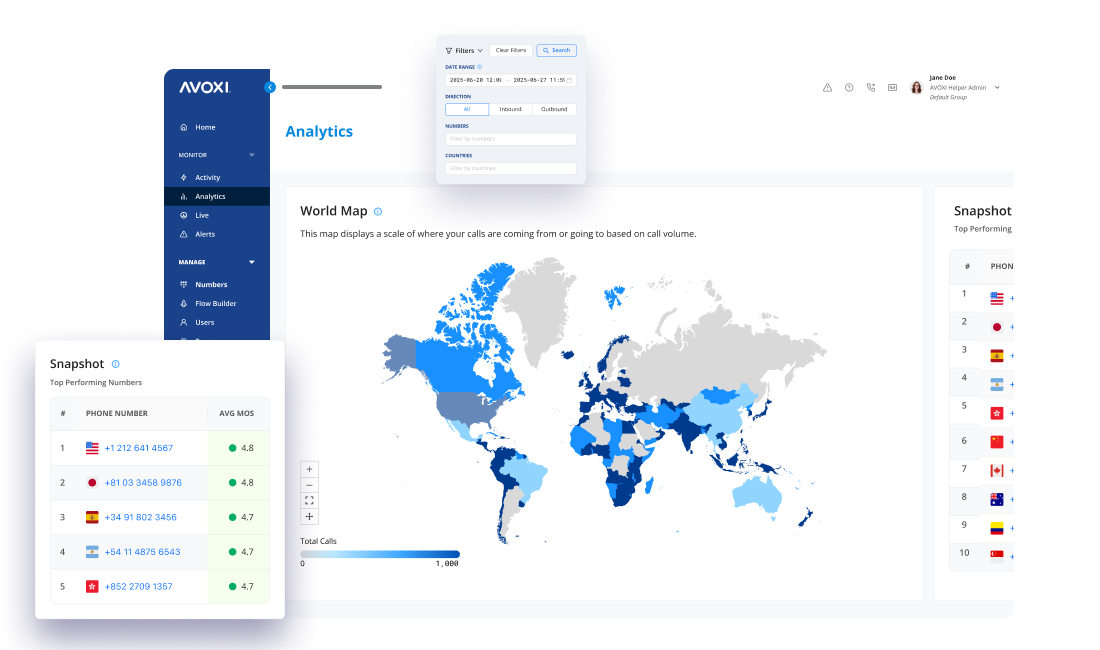
AVOXI's voice analytics break down traffic and usage by number, country, and SIP trunk — the visibility that enables right-sizing global voice spend.
How AVOXI Prices Global SIP Trunking
AVOXI prices multinational voice around one idea: a single platform and invoice across 150+ countries. SIP trunks are $19.99 per month with unlimited channels, virtual number packages start at $6.49, and there are no long-term commitments. That means you get one predictable bill instead of a stack of regional carrier invoices, plus capacity you can provision in minutes and scale up or down without renegotiating.
That low rate still buys enterprise-grade voice. AVOXI runs on 80+ Tier 1 carrier partners with 99.995% global network uptime and a 4.49+ average MOS Score, the benchmark that keeps your customer calls clear across continents.
The payoff is enterprise call quality and global reach, you don't have to assemble carrier by carrier.
Want to see what consolidation does to your numbers?
With AVOXI, every market runs on a single platform and a single invoice, so you can model the savings against your actual routes and volume.
Get a Demo | See AVOXI's SIP Trunking
FAQs About SIP Trunk Pricing
How is SIP trunking billed?
Providers typically bill SIP trunking through a subscription or a usage-based plan. With a subscription, you choose a tier based on its features and flat rate. With usage-based billing, you pay a per-minute rate for the calls you place. Many enterprises blend both across regions to match steady and variable traffic.
What drives the difference between a cheap and an expensive SIP rate?
Carrier interconnect fees, route quality, currency, and regulatory surcharges drive most of the gap. A low headline rate can hide premiums on your busiest routes or rely on lower-quality carriers. Weighing blended cost across your actual destinations and call mix reveals the real price difference.
How many channels are included with a SIP trunk?
It varies by provider, but a single SIP trunk typically carries around 100 channels, each handling one concurrent call. Some providers, AVOXI included, offer unlimited channels per trunk, so concurrency never becomes a separate cost you have to track and provision.

You Might Also Be Interested in

Need Help Getting US Phone Numbers?
We're here to help! Contact us today so we can help find the right business phone number for you.